Common Dog Health Problems

mypuppystory.com

Common Dog Health Problems

When you bring a dog home from a store or shelter, or when you’re getting to know a brand new puppy, the last thing on your mind is taking care of him when he’s sick.

Inevitably, though, something will happen. If you’re lucky it will be a minor problem like flea infection, which can be easily treated. If you’re like most dog owners, though, you’ll have to deal with more serious issues at some point in your pet’s life.

Dogs have the same major organs and systems that humans do, so many canine health problems are the same as the ones we experience. Other illnesses are specific to dogs and some are only seen in certain species; for example, we’ve never heard of a human developing Dancing Doberman Disease (which causes some Dobermans to flex their rear legs uncontrollably.)

The complete list of health challenges that dogs might face is so long that even a veterinarian would have trouble remembering all of them. But the short life span of canines means that potential issues will develop much sooner in your pet than they do in humans. Every dog owner should be familiar with the most common dog health problems, to be able to recognize symptoms or danger signs immediately.

Fleas, Ticks and Skin Issues

Flea collars often prevent fleas and ticks from finding a new home on your dog and some will even treat infestations after they occur, but not all dogs will tolerate them and some dogs can’t wear them (if they’re puppies or pregnant, for example). The same is true for topical treatments. Newer prescription medications do a much better job of preventing flea infestations and tick bites. But of course nothing is foolproof, including the humans who have to remember to give the dog his flea pill.

So how do you know if your dog has fleas or ticks? And what to do next if there’s an infestation?

The symptoms of a flea problem are pretty easy to spot. They include repeated licking, biting or scratching of the skin, hair loss, and bare or oozing red skin patches known as flea allergy dermatitis or “hot spots.” You may even see tiny dark-colored dots on his fur, often called “flea dirt.” If it’s a tick issue your dog may have a fever, or constantly shake his head because ticks like to burrow into ear canals. When you see any of these symptoms, it’s important to take action quickly because one flea can become a thousand fleas in just a few weeks, and ticks can transmit serious Lyme disease.

Some owners prefer natural treatments like flea and tick removal shampoo to kill the pests and then combing them all out of his fur. If you – or your dog – can’t or won’t deal with this routine, oral medications available from your vet can kill the fleas and ticks within six hours, and some topical treatments can get rid of them in a few days.

You’re not completely done, though. All of your pets will need treatment, and the house should also be completely treated, to make sure fleas aren’t hiding somewhere else and ready to come right back. Yes, it can be a pain – but isn’t your dog worth it?

There are other skin issues to be aware of, usually involving hot spots (if they’re not flea-related, they’re called moist dermatitis). They could be the result of an allergy or disease, a grooming issue, or even boredom for some long-haired breeds. Food allergies are often to blame, as is an environmental allergy common among golden retrievers, Labs and Shih Tzus called atropy which causes itching on the face, feet and belly.

You can try trimming hot spots and cleaning them with water-based antiseptic, but a better bet is to see the vet for some hydrocortisone spray or cream. This will ensure that there isn’t a deeper issue as hair loss can indicate anything from mites (which cause mange) to adrenal issues. Food allergies require an elimination diet, atropy is treated with medication. Your dog may need to wear a cone to prevent him from scratching the area until it heals.

Hair loss, usually on the tail, rear legs and trunk, is also a symptom of another relatively common disease in dogs: hypothyroidism. You’re right, the thyroid gland is in the neck but for some reason, when the gland becomes underactive, hair loss occurs toward a dog’s rear. Flaky skin, a dull coat and possibly black skin patches are also early signs of hypothyroidism, which as it progresses causes weight gain, infection and lethargy. If not treated, it can lead to seizures and heart problems as well.

Your vet will prescribe a daily oral hormone which your dog will have to take permanently without lasting effects. Hypothyroidism is most common in medium-to-large breed adult dogs, with spayed females and neutered males more prone to the disease.

Digestive Problems

When your dog starts vomiting without apparent reason or experiences constant diarrhea, chances are pretty good that it’s been caused by the consumption of contaminated food (experts call this “dietary indiscretion”). However, it can also indicate more serious issues.

Let’s look at vomiting first. If it’s a one-time occurrence, it’s probably fine to just clean up the mess and watch to make sure it doesn’t happen again – and don’t forget to check what he’s been eating. If there’s blood in the vomit, or the problem is combined with diarrhea or lethargy, a trip to the vet is called for. At the very least, dehydration could become a problem.

If the vomiting continues and is not an isolated issue, it’s definitely time to load the dog into the car for a visit to the veterinarian. It could be caused by anything from food allergies to bacterial or viral infections, from heat stroke to swallowing a foreign object. All call for professional diagnosis, as do more serious causes of vomiting like pancreatitis, intestinal bowel disease, liver or kidney failure, or life-threatening canine parvovirus. The latter is more likely to affect Labrador and American Staffordshire terriers, Rottweilers, Dobermans and German shepherds.

Diarrhea has some of the same causes as vomiting: dietary indiscretion, food allergies or recent change in diet, infection, foreign bodies, and many of the more serious illnesses we’ve already mentioned. It can also be a sign of something as benign as stress or as serious as cancer.

The first action you should take is withholding food and supplying plenty of fresh water to prevent dehydration. If the diarrhea continues for more than 24 hours, or if you also see signs of lethargy, straining while trying to defecate, vomiting or bloody stools, you know where to go next. Don’t even wait if it’s a puppy that has diarrhea (that could mean a serious disease), or if your older dog’s stool is black which could indicate internal bleeding.

Ear Problems

You probably didn’t know this, but a dog’s ear canal is vertical and not horizontal like ours. That means it’s easy for all kinds of gunk to get stuck inside and cause an ear infection. Dogs who have allergies, lots of hair growth in the ear or floppy ears are most susceptible, but ear infections are regularly seen in all breeds. Yeast and bacteria are the most common culprits, although hair, mites and wax can also be responsible.

You should suspect an ear infection if your dog is scratching the area more than usual, if the area is red, swollen or crusty, or if there’s a colored discharge from the ear. More serious symptoms are prolonged head tilting, walking in circles or a loss of balance. Treatment usually involves an ear cleaning (the vet should do this, not you) and then medication.

Eye Problems

Dogs have many of the same eye problems we do, and many are treated the same way. For conjunctivitis or pink eye, saline eye drops are the first line treatment, with prescription eye drops from your vet required if the problem continues for more than a couple of days. Occasional dry eye issues can be handled with artificial tears, but continuing problems call for a medication that stimulates the tear glands and occasionally surgery is required to move the dog’s tear ducts. Dogs can also get cataracts or suffer from glaucoma later in life, and they’re treated in basically the same way as they are in humans.

There are eye problems common in dogs that humans seldom or never have. Cherry eye is a red tear gland that can pop into view below a dog’s eye if the ligaments holding its third eyelid fail (yes, dogs have three eyelids). The problem is corrected with minor surgery.

Entropion is genetic and occasionally occurs in humans, but is more often seen in young dogs: a part of the eyelid becomes folded into the eye, allowing eyelashes to irritate the cornea and cause infections. Entropion can also be induced by repeated problems with conjunctivitis. Its symptoms include inflammation or excessive tearing in small dogs and gooey discharges from the eyes of large breeds. Both problems may be seen in medium-sized dogs. Antibiotics and artificial tears can help with mild cases, but surgery is often required.

Cataracts and glaucoma can cause blindness in dogs, of course. In some breeds, however, those problems are caused (usually at a young age) by a genetic disease called progressive retinal atrophy, which always leads to blindness. It’s similar to retinitis pigmentosa in humans, and most often seen in Samoyeds, Tibetan terriers and spaniels, Akitas, Papillons and miniature Dachshunds.

Muscular and Skeletal Problems

You likely know that dogs are extremely prone to arthritis as they grow older; it’s one of the most common canine diseases treated by veterinarians. Many owners routinely give their mature dogs supplements like chondroitin and glucosamine even before they contract arthritis, and definitely after they are diagnosed. Because there’s no “cure” for the disease, treatment is aimed at lessening pain as much as possible, and can also include NSAIDs and steroids to reduce inflammation although each of those options can cause major side effects.

One of the conditions that often leads to canine arthritis is hip dysplasia, a malformation of the ball-and-socket joint in the hip that’s usually caused by a mix of genetics, muscle mass and obesity. It’s quite common among large breeds like Labs, German Shepherds, Saint Bernards and Great Danes, and can either show at ages as early as 4-6 months, or in mature dogs when hip dysplasia is triggered by arthritis.

Difficulty in walking or climbing, odd gaits, loss of muscle mass in the thighs and development of larger shoulder muscles to compensate are all signs of hip dysplasia. The condition is diagnosed by a full workup including X-rays, and is treated primarily with pain relief and anti-inflammatory drugs, therapy and weight control in older dogs, with surgery an option for younger ones.

A similar condition, elbow dysplasia, causes malformation and eventual degeneration of dogs’ elbow joints and leads to pain and often lameness. Elbow dysplasia most commonly affects large and giant breeds, and usually is seen in both front legs. The problem occurs most often in younger dogs so surgery, followed by exercise therapy and diet, is a preferred treatment.

Neurological and Brain Problems

Issues seen in humans like Parkinson’s disease and nerve paralysis also affect dogs on occasion. Another disorder common to both, but seen fairly often in dogs, is epilepsy.

Canine epileptic seizures can be caused by a number of issues. Head injuries, anemia and blood sugar problems top the list, but epilepsy in dogs can also be triggered by poison, kidney or liver disease, encephalitis, strokes or cancer. Some breeds like German and Australian shepherds, collies, beagles and Labs can also have seizures without a diagnosable cause. As with humans, dogs can have either full-fledged grand mal or smaller focal seizures.

If your dog is having a seizure, don’t panic and don’t try to keep him from “swallowing his tongue” – dogs won’t choke during a seizure and may bite. Time the seizure (so you can tell your vet), pet and soothe him, cool him with a fan if the seizure lasts more than five minutes and wait for it to end. Then call your vet immediately. The usual treatment for dog epilepsy is medication that can damage the liver so regular blood tests will also be required. A normal life should be possible, however.

Some neurological diseases like distemper and rabies are well known and often fatal, but that’s why you have your dog vaccinated, right? Many other diseases are only seen in specific breeds including the Dancing Doberman disease we mentioned earlier, as well as a similar issue that hits Scottish Terriers known as Scotty Cramp.

Heart Problems

It’s not unheard of for a dog to suffer a heart attack, but it’s extremely rare. About ten percent of all dogs do have heart issues, though, and by far the most common is valvular heart disease (VHD) which primarily affects older, small-breed dogs. The disease involves the thickening of heart valves so they’re unable to supply adequate blood to the body (known as congestive heart failure) and sadly, there are no early symptoms. VHD is a progressive disease which eventually causes loss of appetite, breathing problems, coughing and even fainting. Treatment can include diet modification, exercise, diuretics and medications like beta blockers, but there is no cure.

A genetic heart disease, subvalvular aortic stenosis (SAS), is sometimes seen in larger dogs like Rottweilers, golden retrievers and Newfoundlands. It is caused when abnormal tissue grows in the aorta, obstructing blood flow and causing congestive heart failure. The symptoms and progression of subvalvular aortic stenosis are similar to those of VHD and sadly, so is the prognosis. However, researchers are testing an unusual surgery using a balloon with blades attached to it to open the obstruction, and so far it has shown promise.

You may not be aware that many services are now available that offer genetic screening for dogs, and since researchers have identified the gene responsible for the development of SAS, it’s one of the mutations which can be identified through genetic screening.

Cancer

Cancer doesn’t only affect us. 41% of Americans will contract some form of cancer during their lifetime – but 50% of dogs develop cancer after the age of 10. It’s the leading cause of death in older dogs.

Canine cancer can attack almost anywhere in the body, with lymphoma, skin cancer, breast cancer and bone cancer among the types most commonly seen. It’s believed that genetics are partly to blame, as some breeds are more susceptible than others. About 60% of cases are treatable or curable with surgery, radiation and chemotherapy, and other experimental techniques like tumor vaccines are also being tested.

As with humans, though, the best approach is prevention. That doesn’t mean you have to get your dog to stop smoking, of course, but the two best things you can do to protect your dog is to provide good dental care to prevent oral cancers, and spay females to reduce their risk of breast cancer.

Choosing The Right Dog Diet

mypuppystory.com

Choosing The Right Dog Diet

When we take a dog into our lives, we’re actually making a contract. In return for companionship and affection, we’re promising the same – plus shelter and food.

It’s easy to know whether the shelter you provide – whether it’s outdoors, in the house or at the foot of the bed – is sufficient to keep your dog happy and safe. Food, though, can get a lot more complicated.

Is keeping a bowl filled with cheap kibble more than enough, or do you have to find a gourmet brand? Is dog food or “human food” a better option? Does it make sense to pay higher prices for premium, super premium, organic or grain-free brands? And what about those people who spend hours making their own pet food – are they crazy or are they doing the right thing to keep their pet healthy?

You’ve probably already guessed this, but there’s no “right” answer to the important problem of choosing the right diet for dogs.

Think of it this way. If you could afford it (and weren’t a vegetarian) you would probably want to serve organic meat and produce to your family, because those are the healthiest options. But you certainly wouldn’t give your infant a grass-fed bison steak with a side salad made from organic greens and apples, along with a glass of organic wine. On the other hand, you wouldn’t want be thrilled to sit down to a scrumptious dinner of baby food or infant formula.

Humans – and their dietary needs – are all different. The same holds true for dogs, particularly because canine dietary requirements depend not only on their age, but also on their size, food sensitivities and allergies.

What follows is a comprehensive look at how you can choose the right diet for your dog, along with important information about dog food that most people have never considered.


What Is a Quality Diet For Dogs?

As you now know, if you didn’t know already, the right diet really depends on the dog. But there are some basic facts about canine nutritional needs which should shape any decision you make about the ideal diet for your pet.

Dogs Are Not Strict Carnivores

Cats are what are called “obligate” carnivores; they need to eat meat in order to survive and thrive. Dogs, on the other hand, are “scavenging” carnivores. They prefer meat and need it to thrive, but they can survive just on vegetable matter if necessary.

That doesn’t mean a vegetarian diet is good for your dog. But unlike a cat, your dog can benefit from small amounts of vegetables and quality fillers like rice or oats like which provide carbs, fiber and minerals and are usually included in dog food. Some canines enjoy veggies like broccoli or carrots and they’re fine as occasional treats; mixing extra vegetables into an overweight dog’s food is often recommended as a way to provide a filling meal with fewer calories. Just be sure to avoid raw potatoes, onions and avocado which can cause serious illnesses.

Dogs Need Plenty of Meat

The rule of thumb often cited is that protein should make up 20-30% of a dog’s diet. That’s not a terrible guideline, but in reality, it’s just a “minimum” number that food manufacturers use. Most stick to the minimum because meat is an expensive ingredient. There’s no need to be concerned with “too much protein” in your dog’s diet as long as he’s healthy; he’ll just excrete the rest through his urine with no damage to his kidneys. The bigger problem is “too little protein,” because dogs need 22 amino acids to thrive but can only make 12 of them internally. The rest have to be supplied by the protein they eat.

If you’re concerned about how much meat your dog eats, think about dogs in the wild. Do you think they stop eating the animals they catch, in order to graze in a wheat field to make sure they’re getting a balanced diet? When it comes to protein the big issue isn’t quantity, it’s quality. We’ll deal with that subject shortly.

Dogs Need Water

Even first-time dog owners know they have to put out a bowl of water for their new pet. In general, dogs need at least one ounce of water per day for each pound of body weight. For most, that’s not a problem – you don’t normally have to worry about your dog’s water consumption. However, if you have a pet that shows signs of dehydration (usually due to illness), or doesn’t seem overly interested in his water bowl (or less-healthy options like toilets or puddles) canned food is around 75% water and should definitely be considered.

Dogs’ Diets Should Depend On Age and Size

Once a puppy is old enough to “look like a dog,” many people simply buy them “dog food.” However, that ignores the fact that dogs have three life stages with different nutritional requirements. From birth to 12-18 months (depending on breed) more protein, calories, fat and phosphorus are required for growth. In adulthood (until age 6-8) a maintenance diet is more appropriate because it provides more carbohydrates for energy, and it’s lower in calories, fat and protein to prevent the common problem of obesity in adult dogs. Older dogs usually have more difficulty metabolizing and digesting food so calories are lowered, protein is more digestible and fiber is increased.

There are many who don’t want to bother with those distinctions, or who have several dogs in different life stages who share food. There’s an easy answer. Some foods are approved “for all life stages” (we’ll look at the approval process shortly) and can be safely fed to puppies, adults and older dogs unless they have specific health issues or circumstances. There are separate foods for lactating or pregnant dogs, as well as those with joint, urinary, dental or other problems. In the latter cases, it’s best to consult your vet.

There are lots of dog foods on the market supposedly developed for specific breeds, but that’s primarily a marketing gimmick. There’s no evidence that breed-specific foods benefit dogs as long as they’re being fed an age-and-size appropriate diet. For example, small breeds have smaller stomachs and higher metabolisms, so they should be fed foods higher in calories than large breeds, particularly when young. Large breeds, on the other hand, are more likely to develop arthritis as they age, so food containing antioxidants like chondroitin would be appropriate.

AAFCO

The Association of American Feed Control Officials is the organization that sets maximum/minimum nutritional standards for pet food. AAFCO doesn’t test or approve specific foods, it’s not a government agency, and many large pet food companies are on the board of advisors. But it’s the best we’ve got, and most major manufacturers make sure their food meets AAFCO standards. It’s good for their business as well as for dogs’ health.

The best way to know what you’re feeding your dog is to read the label carefully and have a deep knowledge of canine nutritional needs. That’s a huge assignment, though. The next best choice is to look for an AAFCO statement of “nutritional adequacy or purpose.” If a food’s label says “complete and balanced” for a specific life stage or “for all life stages” it may not be the best food available, but it will be a safe choice. AAFCO also has standards for “natural” food, meaning it can’t be highly processed or include artificial or synthetic ingredients.

What’s In Dog Food?

Sometimes, real meat is in dog food. If you read the label, though, you’ll often see ingredients like by-products, meal and by-product meal. What is all that stuff?

If you don’t have a strong stomach, you may want to skip this section.  By-products and meals are made from the parts of an animal that aren’t really meat. They’re not fit for humans to eat, but they’re approved for pets.

  • By-products are animal parts like cleaned fatty tissue, kidneys, brain, lungs, stomachs, heads, blood and bone, but not hair, horns, teeth or hooves.
  • Meal is higher-quality than by-products. It is made after rendering (cooking to remove fat and kill bacteria) the animal carcass, including the skin and bones, after the “real meat” has been removed. Parts like hair, feathers, stomach contents and manure are supposed to be removed first.
  • By-product meal is made by rendering only the by-products.

Before you run to the cabinet and throw out all of the dog food in your house, there are a few things you should know.

First, the fact that you wouldn’t eat this stuff doesn’t mean your dog wouldn’t eat it. Most of these animal parts are routinely eaten by dogs in the wild; they don’t read labels. Second, those are what manufacturers are allowed to use in making by-products and meal. Not all manufacturers include all of those livestock parts.

Importantly, there’s a huge difference between “beef by-products” or “chicken meal,” and “meat by-products” and “meat meal.” When the ingredient only specifies “meat” there’s no telling what animal it came from – or where it came from. It could be beef, but it could also be pigs’ heads, horsemeat or even the remains of euthanized dogs or cats from an animal shelter. The generic word “meat” on a dog food label is bad news.

But most importantly, by-products, and particularly meal, aren’t necessarily bad ingredients. Manufacturers use them because they’re a cheaper and more concentrated form of protein, and meal can actually make a food better by increasing its protein content. If your food comes from a high-quality producer you shouldn’t be scared off; by-products and meal aren’t necessarily evil, but some manufacturers can be.

What else is in dog food? You’ll find vegetables and grains (often processed into meal to be digested easily) to provide protein and carbohydrates. Vitamins and minerals are usually added in some form to create a balanced diet and for their antioxidant properties, and small amounts of fats are usually added as well. Lastly, many manufacturers add preservatives and colorings, as well as chemical agents to hold wet food together.

None of those ingredients should be harmful in and of themselves, but many owners prefer to avoid foods with any artificial additives. As we’ve said before and will say again, be sure to read the label.

Identifying High-Quality Foods

Have we mentioned reading the label? Sorry to be redundant, but there’s no other way to identify high-quality dog food. You can’t just rely on advertising claims or brand names.

Before plunging into the fine print on a label, here’s what you need to know. Ingredients on any pet food label are listed in order of weight, so the ones at the top of the list are the most important. Also, if a dog food label advertises a single ingredient like “Acme Chicken Dog Food,” it has to contain at least 95% chicken. If it advertises that it’s a “beef entrée,” “beef dinner” or “beef platter” it must contain at least 25% beef.

The first listed ingredient on the label should be a specific real meat, like lamb, beef or tuna, not a by-product or meal. If there’s just one meat near the top of the list, then specific meat meals (remember, generic “meat meal” should be avoided) should also be high on the list. That’s because fresh meat contains too much water to be the only protein source in a high-quality dog food.

Vegetables and/or fruits should be several of the major ingredients in a quality dog food, are should preferably be unprocessed so their vitamins and antioxidants haven’t been cooked out. If you haven’t decided to go grain-free (a controversial subject among dog owners) whole grains should also be pretty high on the list. It’s difficult to come up with ideal percentages of protein, carbs and fat because they can differ greatly according to dogs’ size, age and health, but fewer carbs, more protein and 10-15% fat are almost always a good place to start.

Ingredients to Avoid

We probably don’t have to tell you this after our detailed look at meat, but definitely avoid any protein labeled generically (“meat” or “meat meal”) and if you can, skip any foods with by-products. It’s best to avoid corn and soy because corn is a known allergen that doesn’t contribute much to a diet, and soy can hurt a dog’s endocrine system. Many owners also avoid wheat because it can be an allergen, but it won’t hurt a healthy dog – in fact, it can be a good energy source if a dog isn’t allergic to it. However, skip a food that has lots of different wheat products on the label (or any other grain, for that matter), because the manufacturer has likely split the grain into a number of forms so it appears lower on the ingredient list.

Added sugars may make the food taste better to your dog, but there’s no nutritional benefit to corn syrup, glucose or fructose. The meat will taste just fine without them. The same goes for added artificial colors and flavors, and preservatives like BHA and BHT. Your dog won’t have to be encouraged to eat, trust us.

Natural Diets for Dogs

A “natural diet” can mean two different things to dog owners. We’ve already described the AAFCO standard for store-bought natural dog food, which can’t be highly processed or include artificial or synthetic ingredients. A number of commercial products meeting that description are available and while they’re potentially a healthier diet, there’s no real regulation of what can or can’t be included. Want an example? Theoretically, meat by-products are “natural.” That doesn’t mean you’d want them in a high-quality food.

The other generally accepted meaning of a “natural diet” for dogs involves preparing food for them at home. Some owners cook their own dog food, but most who prepare a natural diet for their pet give them raw food because that’s what dogs eat in the wild – and it doesn’t get more natural than that.

A typical raw diet includes organ meat (like liver or kidney), muscle meat, bones, fruit and vegetables, raw eggs and yogurt. There are benefits to this type of natural diet, including shiny coats, healthy skin and lots of energy. The majority of dogs who aren’t used to processed food also love eating raw. There are also drawbacks like potential dietary imbalances (getting healthy proportions right isn’t easy), the danger associated with eating bones, and allergic reactions.

The biggest issue, though, is contamination. One study has found that 60% of raw meat available for purchase contained E. coli and 7% contained salmonella. That’s dangerous both for the human preparing the food and the dog eating it.

Consult with your vet before deciding to try a raw diet.

Dietary Supplements for Dogs

Most healthy dogs don’t need extra vitamins or dietary supplements. In fact, they’re probably getting everything they need if you’re giving them high-quality food.

However, there are a number of supplements available for canine health issues. Most commonly, older dogs can be helped with chondroitin or glucosamine for joint health, supplements with fish oils can help pets with dry coats or flaking skin, and vitamins C and E are useful for dogs with inflammatory problems. If you really feel that you want to give your dog “something extra,” there are pet probiotics on the market which can help the immune system and digestion.

How Much Should I Feed My Dog?

Here’s another question: “What kind of fuel economy will I get from a car?”

Obviously there’s no correct answer to the second question, just as there’s no correct answer to the first. Dogs are different sizes and weights and some are more active than others, just as cars and engines are different sizes and you’ll better gas performance with different types of driving.

Puppies should eat three times a day and adults should eat twice a day, but the amounts vary considerably depending on how big and how active they are. Start with the feeding recommendations on the food you purchase, and lower them for smaller or sedentary dogs while increasing them for larger or frisky pets. After two to four weeks, check to see if your pet is gaining or losing weight and adjust accordingly. There are calculators online that can give you suggestions, but you’re the one seeing and playing with your dog every day. You’re the best judge.

One final note: free-feeding a dog is not a good idea. House pets are at high risk for obesity, and having food available all the time will encourage yours to over-indulge. It may be the easiest way to handle your dog’s dinner, but it’s definitely not the healthiest.

Training Your Golden Retriever

mypuppystory.com

History of the Golden Retriever

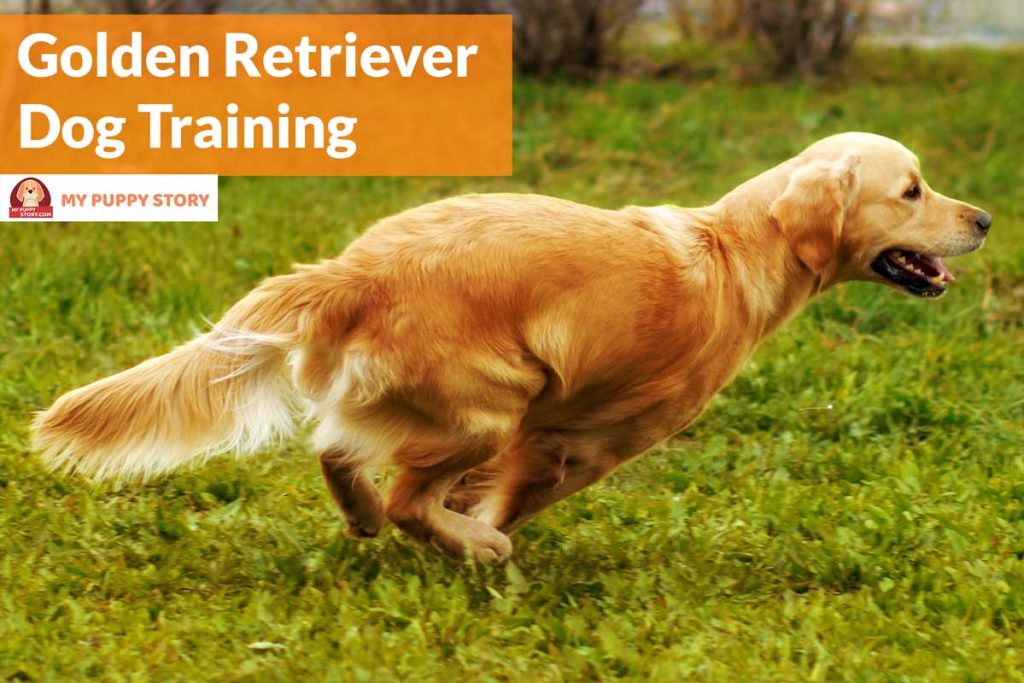
With a noble and distinguished history, Golden Retrievers have been beloved by families since Lord Tweedmouth brought Nous home in 1865. After being bred with Belle, the yellow pups created a unique line of retrievers that were officially recognized as the Golden Retriever breed by the AKC in the mid-1920s. They remain a popular choice for loving owners today.

Goldens were originally bred for the purpose of being biddable, as well as very calm and sensible, for using them as hunting dogs. These popular dogs excel in obedience competitions and as show dogs, as well as for tracking and service. In fact, several organizations train Goldens, Labs, and Lab-Golden mixes almost exclusively, including Paws With a Cause, Canine Companions for Independence, and Assistance Dog International.

Perfect Family Dogs

Their patient nature makes Goldens the perfect family dog as well. They’re great with kids and enjoy spreading their love around the entire family. They may not be your best choice if you’re looking for a guard dog, however, since they basically love everybody.

They do need plenty of good healthy exercise for avoiding weight gain and boredom. Exercise also helps them with maintaining their rather large frames. So, to keep them in good condition, Goldens require one or more long brisk walks, runs, or jogs every day. And, since they are, after all, retrievers, games of fetch are one of their favorite exercises, however, they also love swimming as well.

Golden Retrievers are consistently ranked among the top five dogs in the United States for popularity. There are numerous very good reasons why that is, including:

  • Wonderful temperaments
  • Very gentle with children
  • Easy to train
  • Reliable
  • Hard workers
  • Always in demand as search and rescue and assistance dogs

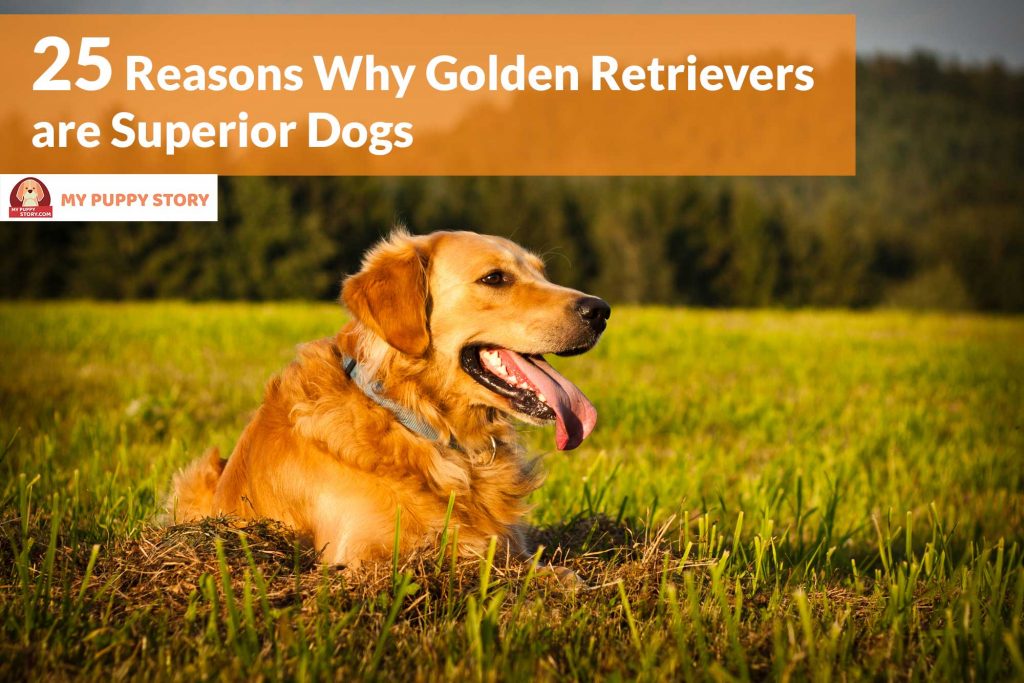
25 Reasons Why Golden Retrievers Are Superior Dogs

Importance of Training

With all of these positive attributes and impressive history, it’s easy to see why Golden Retrievers are so eager to please and easy to train. And, training for these beautiful animals is a very important part of their lives. Goldens should definitely have some important basic behavior training. This includes learning the proper response to verbal commands like “drop it”, “down, stay”, and “come”.

Your Golden especially needs training for properly and reliably responding to those three commands, since they can be used for averting disaster. In fact, any one of them could end up saving your beloved Golden’s life at some point. Training sessions with your Golden should always be fun for you both, involving only positive reinforcement of the kind of behavior that you want your dog to exhibit. In addition, all training sessions should always have a positive ending. Safety and a long happy life are, of course, your main goals with your Golden but good behavior and reliable actions from him are some of the additional benefits of dog training.

Positive Reinforcement Behavior Training

The fact is that positive reinforcement could involve a number of things, such as social rewards, treats, or toys. Research has found, however, the answer to the question of whether they prefer food or praise, the majority of dogs preferred either their owner’s praise over food or liked them both equally.

The best case scenario is that your Golden is successful at learning to quickly and reliably respond to your commands each and every time no matter where you both may be and regardless of whatever is happening around you. Before getting started with the actual training, start first with one simple word to remember and that word is “fun”.

The key to this type of training is making sure that your Golden really wants to perform the behavior involved rather than feeling that he or she is forced to do it. Therefore, using anything that will get your dog willingly into the game of positive reinforcement behavior training is great. You always want to make it appear that you and your Golden are about to be having lots of fun. You can do this by using treats and toys, as well as playful body language and a soothing playful voice.

Learn How to Apply Positive Training for Puppies

Recall Command

The “come” command, aka the recall command, may seem simple but it can be one that is a bit challenging when you’re trying to teach it to your Golden. This is because you should only be using this command if something good will be happening to your Golden when he or she responds to the command, not if you plan to scold or do anything else that your dog won’t find enjoyable. In the event that your Golden is already aware that a scolding is at the other end of that “come” command, then you’ll have to change your recall command to something else, like “now” or “here”.

Using a cheerful tone of voice when you call your Golden is an important part of their training. Even in difficult or stressful situations, it is necessary to remain optimistic as this will encourage your pup to come back home. Panic or anger may discourage them from returning, so focus on staying positive.
When teaching your Golden a recall command, it is important to know when to use the command and when to avoid it in order to ensure success. During the learning process, try to avoid using the command while your pup is engaged in an enjoyable activity as this could lead to an undesired response.

In any situation where it’s possible that your Golden may not come when called, it’s crucial that you don’t provide an opportunity for him to fail. Just go to him calmly and snap the leash to his collar. In addition, it’s important to bear in mind that some dogs have a tendency to block everything out while having great fun sniffing the great outdoors. So, until the time comes that your Golden reliably responds to the recall command, never assume that he’ll come when called if he’s off-leash. Better safe than sorry, so keep him on a leash until you are completely sure that he will respond to your recall command no matter what.

The Drop It Command

Teaching your pup the drop it command is essential for their safety. Not to mention, it makes for a much more pleasant experience when playing fetch or any other game with your Golden. When training, you can use a positive reinforcement technique such as trade-offs between the item in your pup’s mouth and a treat in your hand. This can help establish good behaviors and make learning the command simpler.

Here are the basic steps involved in teaching the drop it command to your Golden:

Hold your Golden’s favorite toy in your hand, telling him to take it from you. Let him play with it for a few minutes prior to beginning training, but don’t let him play with it so long that he starts getting bored with it.

While he has it in his mouth, hold a treat in front of his nose. Then, give him the treat when he drops the toy.

Repeat as often as necessary until he responds reliably.

Now, hold a treat close to his nose while clearly and convincingly adding the verbal drop it command.

Following a few repetitions, hold the treat in front of his nose, gradually increasing the distance when he responds to the command.

Follow all of this up by using the command without a treat, praising him when he drops the toy.

Down/Stay Command

Let’s say your Golden runs out your front door and then is lucky enough to make it across the street in one piece. If you were to give him a come command, it would cause him to run back into traffic to obey you. That’s when the down/stay command is such a critical part of your dog’s learning. He’ll respond immediately to your down/stay command and then you can run to him, snapping his leash on his collar and bringing him back to safety. In addition, this is a must-have command when you have a big friendly dog who loves greeting everybody by happily jumping on them.

Here are the basic steps for teaching this command:

  1. Take your Golden to a familiar spot where there will be no distractions. Stand in front of him and look him in the eye, giving him your full attention.
  2. Give him the down command, tempting him into position using a treat. Don’t give it to him yet but let the treat come in contact with his nose as he is lowering himself.
  3. When he is in the down position, use the stay command and follow it with some treats for preventing him from leaving his position.
  4. Starting with a five-second stay, teach your Golden Retriever the release command and reward them for a job well done with a special toy or treat. Encouraging positive associations between toys, treats, and staying will help your pup remember the desired behavior.
  5. Gradually lengthen the down/stay time by two-second increments while simultaneously decreasing the rewards given after each successful stay. This will help your pup develop reliable responses, even without treats or toys as a reward.
  6. Don’t increase the distance between your Golden and you until he performs consistently in close work. If he breaks his position when the distance is increased, turn your back on him while you hold his treat in your hand and say something along the lines of “oops” or “uh-oh”. Then, you’ll need to allow him a minute or two for putting together the connection between cause and effect prior to trying again.
  7. Gradually reducing both the toys and the treats until he’s only receiving them intermittently upon responding appropriately will complete the learning of this command.

When to Start Training Your Golden

From an early age, puppies with short attention spans can start picking up simple commands such as “sit,” “stay,” and “down.” Formal training should begin at around six months of age, when your pup will be more receptive to it than before.

Your Golden is inclined to want to follow the pack leader and, guess what? That’s you. They can sense your level of confidence and, if it’s low, they’ll just take over and control you instead of the other way around. This can lead to some bad behavioral issues, including but not limited to chewing, anxiety, leash-pulling, and excessive barking. So, be the pack leader and show your leadership qualities at all times with your dog. Gentle but firm all the way is the key to training your Golden.

From the very beginning of your pup’s training, demonstrating your leadership abilities is extremely important. This will guarantee that your Golden grows into a confident and balanced pet, and is well-behaved throughout their life. Consistency is key to being an effective leader so make sure you apply it from the start.

Everything You Need to Know at Each Stage to Ensure Your Cute and Playful Puppy (Your Puppy Month by Month)

With Your Golden Retriever Puppy Month by Month, new pet owners have access to all the knowledge and advice they need to ensure their pup’s growth into a healthy and well-adjusted companion. Veterinarians, trainers and breeders join forces to provide answers to any questions asked or not asked – such as… Learn more about the book


The Complete Golden Retriever Handbook

“Having been a golden breeder for 40 years I bought several copies to keep on hand to pass out to puppy buyers, but I now realize I need to buy more copies… This book is ideal for first time (and even experienced) golden owners, people who foster goldens & new golden breeders or exhibitors,” HELEN DORRANCE, AKC BREEDER OF MERIT, TEXAS, USA Learn more about the book

How to Train Your Golden Retriever in 30 Days or Less

If you want to train your golden retriever quickly but have never trained a dog or have struggled to raise a dog, then keep reading….
• Did you just purchase or adopt a golden retriever but don’t know where to start?
• Do you feel like you are too busy and just don’t have enough time to raise your golden retriever? Learn more about the book

25 Reasons Why Golden Retrievers Are Superior Dogs

mypuppystory.com

25 Reasons Why Golden Retrievers Are Superior Dogs

Should You Get a Golden Retriever?


Golden retriever by mypuppystory.com

1. Super Friendly

If you have been looking for the best friendly pet to bring into your family, then you should think about Golden Retrievers. There are many reasons why Golden Retrievers are superior to other dog breeds, and one of the reasons they make everyone fall in love with them is because they’re super friendly. They will let you in close and will become your best friend. They love playing with you and don’t get angry often. Their easy-going personality is something you will appreciate, as is their eagerness to please you and your family. And that is why you should own a Golden Retriever.


Golden retriever by mypuppystory.com

2. They are Quiet

A golden retriever is a type of a large-sized breed of a dog that is usually calm and quiet, easy to train from basic to advanced levels of obedience. They have an enormous love for water and games with familiar faces. The golden retriever is a breed of dog with a long coat and a denser inner coat that offer them enough warmth in the outdoors which probably contribute to their calm and quiet nature. It’s gentle and friendly nature makes it unsuitable as a professional guard dog. However, it is quiet, calm and very lovable, thus making it one of the most popular dogs in the history of the United States.


Golden retriever by mypuppystory.com

3. They are Eager to Please

There are some pets out there who are simply a mess, or those that are very clingy and take up a lot of attention, time and energy of their owners. Not the Golden Retriever! This particular breed of dogs are so intelligent that they are always looking for ways to please their owners and make them happy. Goldens will always ensure that you enjoy having them around. They will willingly and enthusiastically obey your commands (with proper training, of course) and always be there for you when you need them, be it during happy or sad times.


Golden retriever by mypuppystory.com

4. Great with Children

Most children love dogs, but not all dogs love children. If you have kids, you would definitely want a pet that is friendly and playful; one that is able to offer good company for your children. Golden Retrievers are not only cheerful around children, they are equally gentle as well. Not only that, their intelligent nature means that a Golden Retriever would know how to look over, protect or even save kids and newborns, should the need arise.


Golden retriever by mypuppystory.com

5. Sweet and Loving

There are many reasons for a person to choose a Golden Retriever as a pet, and one of those reasons is the fact that they’re sweet and loving. If you are looking for a kind of dog who is going to love you after a long day’s work, or on pretty much any occasion, there is no other like the Golden. Eager and enthusiastic, a Golden Retriever is known to put on its part hats and celebrate with you when you are happy, and step in to cheer you up whenever you are feeling downsome- definitely a reliable, 24/7 furry friend.


Golden retriever by mypuppystory.com

6. They Get Along with Other Pets

When a new pet is brought into a home, it is important that the pet gets along well with the family. Intelligent and gentle, Golden Retrievers are quick to warm up to your other household pets, including cats or other smaller animals. Their calm nature will also mean less, or no “furry quarrels” at home. In addition to the good company, Golden Retrievers will often help you look out for pets too. Golden Retriever Training Tips


Golden retriever by mypuppystory.com

7. Their Sense of Smell is Impeccable

Golden Retrievers are amazing dogs who are intelligent, enthusiastic and playful. This breed of a dog has a keen sense of smell as well. Although less relevant as a household pet, this unique talent explains why you often see Golden Retrievers at the airport, border crossings and seaports, where they help in tracking down fugitives, or cracking drug trafficking etc.


Golden retriever by mypuppystory.com

8. Hardworking

Dogs are known to be man’s best friends for the longest time. Many keep dogs for security, company and companionship; and dogs work hard to “earn their keep” over the decades. Outstanding as they are, Golden Retrievers are typically more hardworking and attentive than most average dog breeds, allowing them to excel in more advanced tasks like hunting, tracking, detection of narcotics, search and rescue, as well as to guiding the blind. Regardless of the task at hand, you can always expect a Golden Retriever to give it all its got.


Golden retriever by mypuppystory.com

9. Highly Adaptable Pets

Fancy a pet that can adapt to any surroundings as good as you can? The Golden Retriever is tolerant towards the hot and cold, and wouldn’t mind accompanying you on one of your work or road trips. They are not fussy pets either, and will be easily contented staying indoors or outdoors on a typical day.  Their ability to adapt to any given environment is one of the quality that makes them stand out.


Golden retriever by mypuppystory.com

10. They’re Attentive to Their Owners

Golden Retrievers were bred to be attentive towards its owners- one of the breed’s biggest strengths. Fully attentive and enthusiastic, these furry companions are eager to please and will bond closely with their masters. Goldens make faithful companions. If you want togetherness, you will enjoy the attention your canine will give you. He will follow you from room to room and sit with you in the kitchen. This is the best dog to bond with as it is downright needy in its desire for human attention.


Golden retriever by mypuppystory.com

11. Playful

Golden Retrievers are playful, radiant and energetic, making them a favorite companion among kids and adults alike. As Goldens are intelligent, they pick up fast how certain games and toys are played, and will be in the game before you know it.

Do “terrestrial” games bore you? Fret not, for you will have plenty of time to play and bond with your pooch as well in the water, considering how Goldens are adventurous and love the water!


Golden retriever by mypuppystory.com

12. They’re Sporty Companions

You don’t have to worry about your dog not being able to keep up with you as you jog in the park or as you hike a mountain. As a large and sporty breed, Goldens love to exercise; after all, they were bred to hunt in the old days. In fact, you cannot expect a Golden Retriever to live a sedentary lifestyle as the athletic canine would require a daily exercise of at least half an hour. The fact that the Golden Retriever thrives in a sporty environment makes them the perfect exercise friend. Golden Retriever Training Tips


Golden retriever by mypuppystory.com

13. Strong

Golden retrievers are symmetrical, powerful dogs bred for tough working conditions. Its body consists of muscular, well-coordinated forequarters that enhance its agility immensely. The hindquarters are broad and muscled with equally strong rear pasterns to make up for a solid base and sturdy gait altogether. The medium-length neck merges gradually into the muscular shoulders and its strong back is one of its visible attributes. All said, Golden Retrievers have well-balanced bodies and it’s not hard to see why it ranks among the most popular hunting breeds globally.


Golden retriever by mypuppystory.com

14. Famous

The Golden Retriever does not require much introduction because it is already well known thanks to its long list of wonderful personalities.  Apart from being one of the most popular dogs among the regular Joe, Goldens are often starred in TV series and are happily owned by celebrities and even Presidents like Gerald R. Ford. Wouldn’t it be awesome to own an amazing dog loved by so many?


Golden retriever by mypuppystory.com

15. They’re Great Hunting Dogs

One look and you can tell that a Golden Retriever is meant for hunting. It possesses an extremely eager personality to begin with; it’s like it just wants you to give it the go-ahead to pounce onto something. In regards to its comprehensive appearance, the dog is extremely powerful with a balanced gait that gives it an edge while out in the wild. It isn’t long in the leg, or clumsy. The hindquarters in particular are strongly muscled and broad, with well angled stifles to complement. It’s simply a highly active dog, bred for hard working conditions such as hunting and it’s not that hard to see why.


Golden retriever by mypuppystory.com

16. They’re Full of Energy

This superior breed of dog has great energy and endurance. The reason why they’re full of energy is because in the early days when the breed was developed, they were used to spending long periods of time outdoors, often working for their masters at strenuous activities that required physical effort and stamina.
The fact is that they thrive on activities like this because they’re full of energy. The flip side to this is worth pointing out here too. If their exercise needs are not met in the context of their high levels of energy, this dog can become destructive, especially if he is a young dog and kept in a confined space. The simplest way of putting it is to say that the Golden Retriever is primarily an dog for outdoors because they’re full of energy instinctively due to their breeding and experience.
Whether or not you can meet their exercise and stamina needs is worth considering carefully before you decide to have this superior dog as a pet.


Golden retriever by mypuppystory.com

17. They Love the Water

Having a natural affinity for water is one of the characteristics that makes Golden Retrievers such a superior breed of dog. This is because they can be trained to assist people doing work in or near water such as retrieving waterfowl as a gun dog.
The fact that they love the water is also a positive factor when considering a Golden Retriever as a pet. Long jogs and hikes may not be a thing for everyone to keep fit and in shape. All you have to do is take advantage of the fact that Goldens love the water and let them swim in a nearby lake or in the sea to get all the exercise they need. The Golden Retriever’s thick water-repellent coat keeps his body warm while swimming which comes so naturally to this superior animal.


Golden retriever by mypuppystory.com

18. They have Beautiful Coats

Most of us look not only for pets but rather for beautiful pets. Although beauty is in the eye of the beholder, most would prefer to opt for an aesthetically better pet as a lifelong companion. This is where the Golden Retriever shines. This amazing canine does not need its long list of wonderful attributes to amaze you, as its brilliant and outstanding coat would do the job.

Golden Retrievers are known for their lustrous, distinctive fur coats that come in different shades of gold, which are fairly easy to maintain with regular grooming. Gloating and attractive, a Golden Retriever will surely compliment the beauty of your home, in addition to being an amazing companion.


Golden retriever by mypuppystory.com

19. They have Noble Stature

Most pet owners love the attention their pet gets, and would certainly be delighted to know that Golden Retrievers are bound to “turn-heads”. Golden have a noble stature and are very easy to notice since they stand out from other breed of dogs, thanks again to the attractive and glistening fur.
The maximum height of a male Golden Retriever is 24 inches whereas a female is typically 23 inches, so expect your pooch to stand out, particularly among a sea of common poodles and pugs.


Golden retriever by mypuppystory.com

20. They have soft mouths

Golden Retrievers are superior dogs because they are loving and playful. They have soft mouths (or rather, tongue) and are certianly not shy to use them. So expect plenty of licks and kisses from this lovable and eager canine.


Golden retriever by mypuppystory.com

21. They Live Long Lives

More often than not people have always preferred to have pets that will be their companions for a longer period of their lives. That is why many prefer Golden Retrievers as their pets as they are generally healthy and can live up to 10-12 years, on top of their already impeccable list of attributes. This will ensure that many more years of sweet and memorable moments with your companion.  In addition, Golden puppies will ensure that the joy in your home continues.


Golden retriever by mypuppystory.com

22. They’re Obedient

With the exception of the young and exuberant, Golden Retrievers are typically obedient who learn quickly and thrive on pleasing their owner. This is very important because their size and strength would make them difficult to manage if they are disobedient.
To get the best from your Golden Retriever, it is important to train him from early age to respond appropriately to your commands- a pretty simple task considering the dog’s temperament and high intelligence.
However, it is also a good idea to let a Golden use it’s own initiative sometimes rather than always being obedient. An example of this would be to let him wander freely in a natural park or on a secluded beach where he won’t disturb other users. Although not advisable for young dogs or puppies, this is a good idea for older Goldens because the innate loyalty and obedience of this superior breed means they will come back to you with no difficulty at the end of the day.


Golden retriever by mypuppystory.com

23. They’re Easy to Train

Golden Retrievers ranks fourth on a scale of measuring trainability for obeying commands and well deserves that reputation. They are so easy to train because they are (i) intelligent and are avid learners; ; and (ii) very eager to impress their owners, which is why Goldens always give their best in learning.
When you are training a Golden Retriever to learn a specific task or activity, you can expect to have to use fewer repetitions of your command as compared to training a lesser dog breed.
In addition, Goldens like being kept occupied and indeed need this as a stimulation.


Golden retriever by mypuppystory.com

24. They’re Fiercely Loyal

Golden Retrievers are fiercely loyal to their owner or master. This is an instinct that is learned from the environment they were bred in and for. Spending time with your Golden Retriever whether he is a pet in your home or part of your workforce will foster a fierce loyalty in your dog and forge a bond that both you and your dog will benefit from.
The loyalty of a golden retriever will be clear in its performance as a watch dog. They will bark at strangers as a form of loyalty but are generally aggressive because it is not in a Golden’s nature. However, there are many stories of Golden Retrievers rescuing their owners in difficult or dangerous situations thanks to its combination of intelligence and loyalty.


Golden retriever by mypuppystory.com

25. They’re Well-Mannered

Who doesn’t love a well-mannered companion? With proper training, Goldens can learn and understand what their masters love or hate, as well as how to behave in front of unfamiliar people, making them even more effective companions than they already were. It is always an added advantage to have a pet that does not paint a bad picture in front of your friends and family.

Should You Get a Golden Retriever?

Why Do Dogs Eat Grass?

mypuppystory.com

Keeping a pet is taking on a huge responsibility. It is often said that having a pet is no different than taking care of a child. This is because a pet is completely dependent on you and it is your duty to cater to all its requirements. Among the various animals that people keep as pets, it is dogs which are found to be most common. This does not come off as a surprise since dogs are affectionate, loyal, and easy to train. If you have a dog as a pet, there is not much that you will need to do because, on the whole, dogs are capable of taking care of themselves. However, it is their diet that you would need to give attention to. You will have to be rather vigilant with regards to what they eat, lest they eat something that puts their health in jeopardy.

Do dogs eat grass?

This is not something that many people tend to believe. Grass is not a part of the usual diet of a dog. Hence, when one sees their dog feeding on grass, they are bound to be confused. The first question which would then spring to mind is, why is the dog doing so? Is there a reason for you to worry? Is it harmful to the dog? What can you do about it? These are some of the questions that would swarm your mind when you first notice your dog eating grass. You can be assured that you are not the only dog owner who has to go through this worry.

When anyone or anything eats something that isn’t suitable for its diet, the disorder is termed pica. Pica can be a sign of some form of nutritional deficiency. In other cases, it can also be completely normal with no reason to worry. It is not uncommon to see dogs eating grass and, on the whole, the grass would not incur any harm to your dog. Therefore, if you see your dog feasting on grass, you do not have to worry about its health being placed in the realms of harm.

According to many vets, this is a normal behavior which should not be given much attention. Studies have shown that quite a large numbers of dogs eat plants at one point or another, and grass is the plant that is mostly eaten. Therefore, there is no reason for you to panic.

The reason behind eating grass

There could be quite a few reasons that contribute to your dog viewing grass as its potential diet. There is a conception among some people that when dogs feel unwell due to poor digestion, they eat grass which would induce vomiting, thereby making them feel better. However, most tend to negate this idea because they do not think that a dog can be smart enough to come up with a remedy for an upset stomach on its own. According to studies, only a very small proportion of dogs start eating grass because they were unwell. Most dogs did not show any signs of illness prior to eating grass. Furthermore, grass eating does not lead to vomiting in all cases, so this theory does not hold much weight.

Treating intestinal worms is among the reasons that can make your dog eat grass. When there is worm infestation in the gut, the dog is compelled to indulge in all sorts of dietary habits, and eating grass one of the things that it might do in such a situation.

Nutritional deficiency is also a reason that can lead to your dog eating grass. It might be doing so to fulfill some of its dietary requirements that are not being met. The common requirement which is seen in such cases is that of fiber. According to reports, deficiency of fiber can provoke a dog to eat grass.

One of the most common causes of a dog eating grass is boredom and the taste. It could be that your dog simply likes the taste of grass and wishes to indulge in it because the taste appeals to it.

Is it dangerous?

This is the ultimate question that a dog owner would have when they notice their dog eating grass. Is it something that they need to give attention to or is it something that can be ignored? While grass in itself does not inflict any harm upon the dog, you still need to be cautious.

If your dog starts eating grass excessively, there could be an underlying illness which is responsible for its behavior. Similarly, if a dog vomits after grazing, you need to consult a vet because this can cause weakness and other problems in the dog.

Another thing that you need to keep in mind is that lawns and grass are treated with all sorts of chemicals in the form of herbicides and pesticides. These can be quite toxic and if ingested, they can pave the way for a lot of trouble. Certain garden plants are also detrimental to health. Therefore, this is something that warrants attention. If you notice dogs eating grass and plants, the first thing that you need to make sure is that the plant is not dangerous for the dog and immediate medical attention is not required.

Attention particularly needs to be given if a teething puppy starts to eat grass. This is because ingestion of grass and leaves at this stage can lead to blockage, which can pose a significant danger to the puppy. Therefore, if you see your puppy eating grass, it would be a good idea to take measures that would thwart the habit.

How to stop the dog?

If you want to stop your dog from indulging in eating grass, there are various measures that you can take.

If you have a suspicion that your dog is eating grass because of boredom, it might be a good idea to ensure that adequate exercise is provided to it. Perhaps, it is a bit of attention that your dog requires. Make an effort to keep your dog occupied in different types of activities that would keep it engaged. An interactive game such as playing fetch with a Frisbee would be a nice idea. Another option that you have is to get the dog a chew toy which would keep it captivated and off the grass.

If it is a nutritional deficiency that is responsible for the dog eating grass, you should switch to a different dog food. Endeavor to opt for something that would fulfill all its nutritional requirements. You can also incorporate cooked vegetables in its diet which would prove to be quite effective in preventing the dog from eating grass.

A bit of attention is important

At the end of the day, it is your attention to the matter that would make a world of difference. When it comes to pets, it is important that there is no negligence exhibited in any aspect. Therefore, if you notice your dog eating grass suddenly, you need to dig deeper to find out the reason for it. Failure to do so might cause a great deal of harm to your dog. This is because there is a chance that eating grass was a sign of some underlying illness and by not giving it any attention, you failed to detect it. This could put the health of your dog in grave danger.

Keep in mind that when you keep a pet, you are the one who would be responsible if any harm befalls it. Therefore, chances should not be taken. You need to make sure that you pay adequate attention to all the aspects associated with the pet so as to ensure that optimal care is provided to it. By not doing so, you are basically neglecting your duties. Therefore, make sure you keep a close eye on the diet of your dog and seek help if any abnormality is noticed.

Another reason for people to seek help when dogs start to eat grass is that they do not want their beautiful lawn to be destroyed. Whatever the reason for you taking preventative measures against your dog eating grass, make sure you are patient in your approach. If your dog likes to eat grass, you cannot expect it to give up the habit within a short span. Therefore, do not lose patience and continue to make efforts. You will notice a difference soon enough.

Keeping a pet is all about being patient while you nurture it. This is something that you should be prepared for before you take on the responsibility because once you undertake it, there is no turning back. You will have to take care of the dog to the best of your abilities and protect it from all sorts of harm.

The Truth About Dog Training

mypuppystory.com

Are you the proud owner of an adorable dog? Do you consider yourself to be a master when it comes to having knowledge about how to train your dog? Does this information come from a fellow dog owner and things that you have heard all your life? If so, the chances are that half of the things you believe to be true are myths and lies.

A lot of absurd myths float around about the proper way of training your dog, how much time it takes, and other intricacies of the process. Some of these lies have been around for so long that they are now said with such certainty that you feel as if you don’t have an option other than believing in them. It is as if they are set in stone, unchallenged and ever-living.

Let us debunk some of these lies so that you become more informed and less overwhelmed than before about the process of training your dog. Here are 10 of the most popular lies that we all believe in. Buckle up for some of these facts may shake up all that you believe were the truths about dog training.

Lie #1: Old Dogs Can’t Be Trained

This myth is deeply ingrained in the minds of dog owners everywhere. People firmly believe that they can’t teach an old dog any new tricks. Such a belief has been passed down from generation to generation and is now considered to be such a concrete fact that people don’t even try to train their dogs after they enter the prime of their lives.

However, this notion is a lie. Dogs can learn a trick or behavior at any age. While it is true that teaching a puppy is easier and correcting an action takes a longer time than teaching the proper way to behave in the first place, the fact remains that the act of training is possible. Even if your dog has believed itself to be the pack leader for most of its life, deep down, every dog wishes to be a follower rather than a leader, so your dog would be happy to pass down the throne to you and enjoy its remaining life relaxing.

If you wish to train an old dog, be ready to put in a little more energy than in the case of puppies. However, to say that once dogs reach a certain age, they are untrainable is a ridiculous lie which you should not believe in.

Don’t let this lie bring you down. If you feel as if your dog is exhibiting a bad behavior or habit, get to work and change it.

Lie #2: Small Dogs Are Easier to Train Than Large Dogs

If you have ever asked your family or friends for advice about which dog to get, the chances are that they would have mentioned the fact that small dogs are easier to train than large dogs as an argument for getting the former.

Contrary to popular belief, size is not a factor when it comes to deciding how easy it would be to train a dog. In reality, it has more to do with the breed and individual personality of a dog. Some breeds have a natural predisposition to be dominant and assertive and, hence, are hard to train. Similarly, others are submissive and have no problem adapting to their owner’s command. Such traits can be found in dogs regardless of their size. You may end up owning a large dog whose training is marked by ease and speed or a small one who is demanding and bossy enough to make the act of training it a seemingly never-ending one.

Therefore, you can’t draw conclusions about how easy or difficult the process will be based on the size of the dog. Research about the breed – that is the most you can do – and leave the rest up to fate.

Lie #3: Dog Training Is Time-Consuming

Such a statement may have been true in the olden days, but it is not an accurate depiction of the modern process. This is because dog owners did not have access to proper information and instruction in the past. On the other hand, thanks to an array of online videos that can be streamed, the act of training your dog is now comparatively easier and faster.

Now, dog owners are aware that a well-trained and obedient dog is not a product of hours and hours of work but requires quality training in the form of daily exercises and a proper reward system. You can successfully manage a hectic life and train your dog. It is foolish to assume that there is a trade-off amongst the two.

Don’t view your beloved pet as a complicated animal whose training will sap you of all your energy. Your dog is your friend and it does not require a lot of your time.

Lie #4: Puppy Schools Are the Best Way to Train Your Pet

People tend to believe that puppy schools are the best way to teach pets the proper behavior. However, the truth is that such institutions are not the best approach to tackle poor behavior in pets or even to instill a good habit.

One of the key reasons behind their ineffectiveness can be assessed based on how little effect the school has on dogs compared to the amount of fee charged. Moreover, the classes have a high demand among dog owners, which translates into overbooking of classes and, hence, wastage of time.

Since the most progress your pup will make in four weeks’ worth of courses is responding to sitting commands, you are better off training your pet at home. Not only will it save you a lot of money, but it will also allow you to train and bond with your loyal companion at the same time. Not to mention the fact that training your pet yourself helps establish you as the pack leader.

Therefore, don’t waste your energy and resources on puppy schools. You are better off without them. If you do wish to explore this option, you are at liberty to do so, but don’t expect drastic results. It is better to use such platforms to build a foundation and take up the role of being your dog’s trainer yourself.

Lie #5: You Can Only Have One Alpha in the House

Becoming the pack leader is immensely valuable. Dogs are biologically predisposed to stay in groups and follow a leader and when they don’t see anyone assume the role, they take it upon themselves to be the dominant and assertive one in the equation. Therefore, it is integral that you establish yourself as the pack leader early on in the relationship.

However, a common myth is that only one family member can be the alpha. This belief is flawed. A dog can view multiple people as pack leaders depending on their attitude and how they deal with things. How do you do this? By training them to respect all humans in your home or even in general. Such a process may be tardy, but it will prove to be effective.

A dog can have multiple masters and can realize that all of the family members are its owners. All you need to do is establish a leader like a persona. Know what you are doing, and a calm dog will welcome you. Failure to do so may lead to nasty bites and an aggressive dog.

Lie #6: Positive Reinforcement Is the Only Option

Many dog owners are of the view that dogs should be trained solely via positive reinforcement, i.e., by giving rewards when they exhibit a proper behavior or perform the right action. While there is no denying the effectiveness of such an approach when teaching your dog tricks and good behavior, it is wrong to assume that it is the only approach.

In reality, such an approach may not be as fruitful when teaching your beloved pet about the action it is not supposed to do. Just like when you teach a child, you reward them for their good actions and punish them for their bad ones, a dog is to be treated in the same way.

Mind you, this does not mean shouting at it. You need to earn your dog’s trust and respect. After you have done so, you can put your pets in timeout or deny them treats when they do something against the rules, like peeing in the house or breaking something. Once you adopt this approach, you will notice that your dog will become considerate and more unlikely to break the rules than before.

Hence, negative reinforcements are just as important as positive ones when teaching a dog the proper way to act. Make sure you don’t use either of these approaches incorrectly for they could, then, yield disastrous results.

Lie #7: Training Lessons Take a Huge Chunk Out of Your Wallet

One of the many misconceptions about training dogs is that the best training experiences and methods are always the most expensive ones. The foundation of such a myth is based on the amount of money dog owners are known to spend on puppy schools and pet behaviorists. If you consider such vessels to be the most efficient of all, you will naturally assume that the task requires a hefty amount.

External help may prove to be beneficial in laying the groundwork more smoothly than if you do not seek any help. However, the fact remains that as a dog owner, you can learn all the tricks of training your dog with the aid of videos available online and via an array of dog training sites which offer free advice on the matter. Moreover, if you train your dog without much external help, you get to cherish the memories while learning the art of leadership. It can be said that the best way to train your dog is not only the cheapest method of all, but it is also the most enriched with experiences and memories.

Therefore, if you are worried about how expensive owning a well-trained dog will be, don’t worry. You have been led on to believe in a false assumption. Don’t let it stop you from getting a dog.

Lie #8: Treats Should Not Be Used for Training

It is a popular belief that dog owners should not use treats at all to get their dogs to listen to them. While it is true to say that one should not become dependent on treats to get their dogs to listen to them, it is also true that treats are an excellent way to instill the basics of correct behavior.

A reward is always the best way to show a dog or even a person that their actions are welcome. While such rewards may not always be in the form of food, it is wrong to eliminate them out of the equation altogether. What you do need to learn, however, is to provide a reward when the need truly arises and not when it will not yield any benefit.

It is crucial to learn the art of slowly removing the need of treats after a given action is performed. One way of doing so is by giving these treats sporadically once a positive behavior is established so that your pet doesn’t form any expectations about being giving one every time it performs the action.

Use dog treats, but don’t use them in abundance. Be smart about the system, and you will have no issues.

Lie #9: Destructive Dogs Are Dumb

Another popular notion deeply engrained in the minds of dog owners is that dogs that indulge in destructive activities, like gnawing on furniture, breaking vases, or being chaotic in general, do so because they can’t get the hang of the training you are trying to provide them with.

The truth is the very opposite. Destructive dogs or those who don’t comply with your wishes are, in reality, smarter than dogs who do. The cleverer they are, the more difficult it is to make them give up which, in turn, serves to be a source of a headache for the trainer.

If your dogs portray such behavior, it is your cue to drop whatever practice or approach you are following and try something new. Remember that the key to working with smart dogs is to be smarter than them. Try to understand the reason behind their behavior before you change things up.

Don’t give up on your pup. It will learn and you will find out more about dealing with troublesome teenagers while training your dog. Hence, it’s a win-win for all.

Lie #10: Work Hard. Repeat.

People seem to think that if they put enough energy into the act of training their dogs, it will yield a fruitful result. While that may be the case with some dogs, the key to effective dog training is not how much hard work you put in but how smartly you approach the situation.

If you persist with a wrong approach and work day and night in changing your dog’s behavior in a way which would reflect your hard work, you are in for a rude awakening. Training is not just about putting in your energy. It is about putting in your energy in the right place. For example, if you work hard in trying to teach your dog to pee outside rather than inside the house by giving it a treat every time it pees outside, you are not doing anything to discourage the bad behavior of peeing in the house. In your dog’s eyes, it isn’t faced with a consequence if it does pee in the house. In such a case, regardless of how many times you treat it, the chances are that you may still walk in one day to a stain on your favorite sofa and a dog that doesn’t look guilty about it.

Therefore, make sure that although you work hard, you do so while being smart about it. Don’t repeat a flawed training method day after day and expect fantastic results.

Conclusion

All in all, the fact that such lies exist shows that you should not believe everything you hear, regardless of how firmly a given statement is accepted by many. It is not wise to let such opinions come in the way of providing the best form of training to your dogs.

Always look up the facts when you hear about them from a source which is not credible. This act will help you avoid practices which, at the end of the day, may yield unsatisfactory results.

Train your dogs and provide them with rewards. Be smart and strategic about the time you spend teaching your pup the do’s and don’ts of life, and play your part in shaping an obedient dog.

Everything You Need To Know About Low-Maintenance Dogs

mypuppystory.com

Decided to add a furry fellow to your family? Great idea! Having a pooch could be a very rewarding experience. Dogs are a joy to have around; they are loving and loyal. They add to the happiness and tend to feel down if their owners are feeling low, but at the same time, are always ready to cheer them up.

However, there are downsides of owning dogs as well. Sometimes, it can get annoying. For instance, one gets no free time for themselves if the dog is a heavy shedder or has many issues. All the time goes into chasing after the dog. And not many people are up to that kind of constant devotion as everybody has a busy life.

This is why some people prefer low-maintenance dogs. Everyone has a different definition for low-maintenance when it comes to dogs, though there are some key points to it. A low-maintenance dog, in general, is one that does not have many requirements.

What makes a dog low-maintenance?

A dog that is easy to train

Some dogs are very tough to train and take a long time to get a grip on what they are being taught. Whereas, others are quick learners. This makes it convenient to train them in doing basic things like visiting the washroom, not wandering into unfamiliar territories, and eating at proper timing etc.

A dog that keeps pooping and peeing at every spot in the house could be vexing. No one wants to be tied down cleaning everyday. A dog that enters places where it is not allowed to go could be an issue as well. But a low-maintenance dog that follows its training will not make such mistakes and thus is not a problem to have around.

A dog that is easy to groom

Another factor that counts is to groom the hound easily. Some dogs need a lot of attention in this regard, but those who are low-maintenance just require weekly baths and brushing of fur, daily brushing of teeth and fortnightly trimming of nails.

These dogs do not shed much hair, and that makes for convenience. A dog that sheds too much fur means it leaves behind a trail of hairs from place to place calling for the need of constant cleaning. That is troublesome particularly for people who lead an already busy routine and do not have maids to take to the broom.

A dog that is active in a balanced way

Agile and fun-spirited dogs are fun to hang out with but not for people who do not have the time or energy to keep up with a dog that needs constant fun. A low-maintenance dog is one that is easily satisfied and eager to please his owner. It does require playtime and regular walks but is not constantly hyped. On the other hand, neither is it such a dog downright too lazy to even get up from where it is lying.

A dog that doesn’t get sick easily

Some breeds of dog catch allergies quite quickly. Such dogs make constant trips to the vet and have many needs. With age their problems grow and handling them becomes costly because of the unique requirements. However, a low-maintenance dog is just the opposite. It does not get sick provided proper care is taken. It remains healthy and does not even eat too much.

A dog that gets along with others

Another factor that counts is how welcoming a pooch is. Some canines are aggressive, and that makes them hard to manage. The low-maintenance ones can be described, in a way, as those who are friendly to kids. So, if you are a person with children, then you should feel relaxed with the thought that your children’s safety will not be compromised with a doggie in the house.

Some dogs do not get along with strangers. They start misbehaving when they notice a new person interacting with their owner or getting too close. That could be troublesome. Similarly, if the pooch is aggressive toward other dogs, that could be a problem too.

Low-maintenance breed of dogs

Whether you are a new pet parent or one who has experience with dogs; and want to get a new one that does not require much maintenance, you must be aware that taking in a pet is a huge responsibility. It is not a toy that can be played with for some days and then discarded. It is a breathing mass with requirements. Anyhow, if for that very reason, you want a pooch that is low-maintenance then you should be able to decide which factor of low-maintenance you are most concerned about.

There are many breeds of dogs, out of which some are excellently easy to groom and are low-maintenance in that way, whereas there are some difficult to train as well. Some kinds meet all the standards of a low-maintenance dog. You need to be sure about which breed behaves how so that you can make your decision with certainty.

However, do not fret because pooches are usually super affectionate and loyal companions. Here are 13 breeds of dog that are low-maintenance in their ways. These are the easiest to handle dogs. You can choose whichever you think would suit you best.

Chihuahua

These dogs are small but ferociously loyal. They like to snuggle into dark places like a hump of cloths as they feel secure doing so. The short-haired Chihuahuas hardly require any grooming, and even though they have long ears, you would not have to check those constantly.

The dog is so small that even if you get a long-haired one, its grooming does not take much time. Even a senior Chihuahua does not get any bone or joints problems. Considering their size, they eat only in small or mediocre amounts.

The only downside is that since they are small, their necks are delicate hence you have to be careful with the leash and collar. They are mostly indoor pets, but they like to have regular walks like all other pets do.

Labrador Retriever

Labs are the most loved dogs around the world and that also for a solid reason. This breed of dogs knows how to spread joy. They are low-maintenance despite their large size. They are not temperamental but rather fun-loving dogs. They are active in a balanced way; not too jolly nor lazy either.

They do shed hairs but not much, and overall have fewer requirements. They are easy to train and friendly to children as well. They do not need that much grooming. These dogs are easy to satisfy.

Beagle

This breed of dog is happy with a walk, and it is not always excited. The Beagle is not lazy, and nor active either. It does shed hairs but not too much. Its short fur coat just needs to be brushed and bathed occasionally. They are not quiet and make a lot of noise. They love cuddling with their pet parents and regular play sessions.

With these dogs, you do not have to fret over getting an appointment booked with a groomer. They are small, social, and adorable. They are also great with kids, so it solves your safety concerns for your child. However, the one con is that these dogs are rather hard to train. Training a Beagle could be challenging.

Greyhound

Contrary to popular belief, Greyhounds are couch potatoes. One might think that given they run fast, they would be having a lot of energy; and the owner would have to take this pet for runs rather than walks. But that is not the case. The Greyhound is an indoor animal who likes snuggling into a cozy place like a sofa.

These dogs are low-maintenance as they are clean and quiet. Their short fur is easy to maintain, and their sleek body makes them convenient to have at home. They are calm and tolerant, so they are not a problem to have near kids.

This breed needs to be kept on a leash because they have the urge to run. This might get them hurt or lost and scared. Though they are well-behaved, they need to be taken out for daily walks.


Miniature Pinscher

If you are a lonely fellow who needs a friend, then this is the dog for you. Min Pins are loyal and fun, but they are not tolerant of visitors. Neither are they good to have around kids. They do not require much grooming; their small hairs do not shed a lot and can be handled with regular brushing.

The Miniature Pinscher does not even require much rigid training. They are easy to train and are snugglers. They are small and joyful but not very active. All you need to do is just regularly walk and play with them.


Pug

The Pug is another low-maintenance pooch. It does not shed many hairs and is a joy to have around. All it wants from you is to make it rest on your lap and spoil it by feeding it food. Pugs are not a problem to have around children. These lazy animals consider walking from one couch to another exercise.

They shed a moderate amount. All you get to do to keep them managed is regularly bathing and brushing them. They have a cute sense of humor. These affectionate animals are indoor dogs that cannot stand too much heat.

Dachshund

The Doxie is another dog that does not require much maintenance. They are intelligent, jolly, and amusing to have around. The Dachshund needs less grooming because it has a smooth fur coat that does not shed much.

They love to hang out in packs so if you are looking forward to having more than one; say two dogs roaming around your house then this breed is the right choice. Training could be challenging if done incorrectly, so be careful about that.

Other than that, these food hunters need to be kept an eye on. Because if found a snack lying around they are sure to eat it.

American Staffordshire Terrier

This dog is an active one that requires long walks. If you are a lazy person, you might not be able to keep up with an American Staffordshire Terrier. However, they need minimal grooming. All you need to do to keep it clean is give it baths now and then.

They are fun-loving fellows who get along with everyone. They are eager to please those they love, and that is why you would adore them. They are always ready for an adventure. They love meeting new people as well so they would not trouble near visitors.

They love spending time with their folks and are relatively easy to train. If you need a buddy who is as energetic as you, then this hound would be the right choice.

Boxer

This breed of dog quickly mingles with the family and becomes an active part of it. They are also low-maintenance as weekly brushing of the fur coat keeps them from shedding much. The Boxer is a fun-loving, agile dog that is not aggressive and is rather loyal.

They do not need too much exercise, just regular short walks. They like snuggling with their members and giving wet smooches. They drool and snore while sleeping just like all other dogs. They are not tough to train, but they need to be in consistent practice.

Vizsla

The Velcro Vizsla dogs are very close to their owners. They are very affectionate and love to be around people. They make sure their opinion is being heard by constantly whining and moaning. These dogs are more indoor animals than outdoors. In the winters, they should be kept warm as they do not have an undercoat.

However, this breed of dog is smart and easy to train. They should be kept in control because they can be obstinate and tend to get excited easily. They are low-maintenance as they do not require regular baths and do not shed much. More like cats, they keep themselves clean.

Their odor is not smelly so those who are bothered with dogs because of this reason can rest assured. Weekly brushing is enough to keep their fur from shedding too much. Their nails need to be trimmed once every two months. These dogs are warm-hearted, so they are not a danger to children.

Yorkshire Terrier

The Yorkie is a hypoallergenic breed that is very friendly. Though it is small, it is an alert dog. It is cute and fun to have around. This breed of dog is not any harm for children. You do not need to keep a check on them. As these dogs are small, their requirements are less.

If their fur is cut short, it does not need much grooming either. Even if the pooch’s hairs grow, it can be cut at home every two months. The hairs do not shed much, but they get tangled, so brushing is necessary.

They are miniature and therefore do not require much exercise. Their training is also trouble-free. These small furry buddies can be your partners on the go wherever you head. They are well-behaved and kind to everyone they meet.

Rottweiler

The Rottweiler enjoys hanging out with its owner quite a lot. This breed loves spending time and doing everything with its pet parents, from watching television to sleeping with its owners.

They are easy to train and keep in mind what they are taught. This makes them intelligent. These are not very noisy dogs. Until they are two or three years of age, they cannot even bark.

This breed of dogs is easy to maintain as well. Brushing its coat twice or thrice a week would keep the shedding to a minimum. If you are looking for a consistent companion, the Rottweiler would be an incredible choice.

Bolognese

This breed of dog may be one of the cutest. For people who are lazy and cannot handle the work a pooch requires, but at the same time desperately want a dog, the Bolognese is an ideal choice. The little fellow can be a constant companion and does not require much. It is easy to train as it is smart and catches tricks quickly.

It takes up very less space as it is small. It is playful but not too bouncy and active. A mediocre amount of exercise in the form of occasional walks would suffice. It gets along with other hounds and kids as well but is reserved toward strangers.

Its white hairs are long but do not shed much. So, it requires moderate grooming. Also, it is a hypoallergenic pooch which makes for another pro. It does not particularly have any genetic health issues. All this makes convenient for you to have it around as it does not make you work too much.

Pin or share

How to Tell If Your Dog Is Sick

mypuppystory.com

Keeping a pet requires a lot of hard work. You need to be on your toes at all times so as to make sure no harm befalls it. Most people prefer to keep dogs as pets. The fact that they are easy to train, are loyal and affectionate, and do not require a lot for their care contribute to the popular choice of dogs as pets. However, while it is true that taking care of a dog is a bit easier as compared to other animals out there, this does not imply that you throw caution to the wind.

Often, it happens that people fail to realize their dogs are unwell and thus, timely medical attention is not attained. This can prove to be detrimental and rather dangerous for the dog’s health. Therefore, understanding when your dog requires medical attention is something that you need to give adequate attention to. We are going to provide you with some signs that should alert you that your dog is unwell and attention needs to be given.

Identifying that your dog is unwell

A dog cannot talk and, thus, is unable to tell you when it is facing some issues. Can you imagine the feeling of helplessness that would engulf you if you are experiencing some pain and cannot do anything and cannot let anyone know about it? This is the reason that it becomes all the more important you recognize the signs of sickness in a dog so that something can be done about it.

A lot can be gauged by the body language of a dog. It is important that you know your dog. If you are up to date about the various aspects of your dog such as its behavior, appearance, and habit, it will become a whole lot feasible for you to identify when your beloved is unwell. If you seek prompt intervention at the first signs of illness, you can save quite a bit of time and money.

Let us shed some light on the ways that would tell you that your dog is sick.

Changes in behavior

It should always alert you if your dog starts exhibiting drastic changes in behavior. When your dog starts behaving in a strange manner, this should make you realize that your dog is trying to tell you that something is amiss. Perhaps your dog has become lethargic, or maybe it has become a lot more aggressive. There could also be signs of irritability. There are also chances that your dog starts to withdraw itself or maybe becomes clingy and needy.

To summarize the behavior changes that should be considered a red flag, these are the signs that you should keep an eye out for:

  • Irritability
  • Aggression
  • Clinginess
  • Withdrawal
  • Lethargy

Stomach-related issues

You might also notice stomach issues in your dog including vomiting and diarrhea. It is not uncommon for dogs to develop these issues. Perhaps, your pet consumed too much food or ate something bad. Thus, if your dog only suffers from diarrhea and vomiting, there is no reason for you to worry. However, if these complaints are registered in combination with behavior changes, you should be alerted that there is something wrong.

Just because it is common, it does not imply that vomiting is not something that you should give attention to. There are some situations in which vomiting and diarrhea should be a cause of worry for you.

Frequent episodes of vomiting that last for longer than 24 hours, repeated episodes of diarrhea which last beyond 24 hours, abdominal pain in association with vomiting and diarrhea, blood in stool, and loss of appetite are some signs that should let you know that it is time you seek the opinion of a vet.

Among the various stomach-related issues that can be faced by a dog, one that requires special attention is bloating. This is because bloating can be potentially life threatening and is found to be more common in large breed dogs. Bloating requires emergency medical intervention as any sort of delay can cost the dog its life. Distended belly, uneasiness, restlessness and dry heaves are some of the signs that can give you an indication that the dog is suffering from bloating and should prompt you to take it to the vet at the earliest.

Hence, the factors which need to be paid attention to with regards to abdominal conditions of the dog include:

  • Vomiting that does not stop within a day
  • Severe diarrhea that lasts longer than a day
  • Blood in stool
  • Abdominal swelling
  • Loss of appetite

Respiratory difficulties

The signs of a respiratory illness can either be glaringly apparent or be subtle. Hence, one would need to be rather observant to detect them. You will need to contact your vet if you notice that your dog is having a persistent cough for more than 24 hours or during its sleep. Attention should also be sought if there is persistent nasal discharge. This is particularly important if there is mucus or blood in the nasal discharge. The dog could also be experiencing wheezing, which is an alarming sign. A honking cough is also a sign that needs medical attention.

When you notice that your dog is facing some sort of difficulty in breathing, you need to contact the vet. Furthermore, if there is any other respiratory difficulty that you notice in your dog, you need to take a look at the color of its gums and tongue. If they are not pink in color and have a bluish tinge to them, consider it an emergency situation and contact a vet at the earliest.

Therefore, the signs that you should look out for when any sort of respiratory distress is noted in the dog include:

  • A honking cough
  • A persistent cough lasting for more than 24 hours
  • A cough that hampers with the dog’s sleep
  • Persistent nasal discharge lasting for more than 24 hours
  • Nasal discharge containing mucus and blood
  • Wheezing
  • Struggle to breathe
  • Bluish tinge to gums and tongue associated with breathing difficulty

Bowel habits

Another important aspect that you need to be observant about is related to the bowel habits of the dog. You should consult a vet if you notice there is an increased frequency of urine or if the dog has any trouble passing urine or feces. Dogs are usually housetrained with a lot of ease, and it is very seldom that they break the habit. Therefore, if your dog is involved in a urinary accident more than once, you should think that something is amiss. The same is true for fecal accidents in a properly trained dog.

Therefore, you should consult a vet if you notice that your dog is experiencing:

  • Increased frequency of urine
  • Trouble in passing urine or feces
  • Urinary or fecal accidents

Appearance

More than anything, it is the physical appearance that you would notice the most. You spend hours with your dog. You play with it and look forward to spending your time with it. You are the one who knows it best. Therefore, you can be the best judge to decide if there is something wrong with the dog.

You need to be alerted if there are any lumps or bumps on the body of your dog. Any kind of changes in the already present lumps and bumps should be tested by a vet. Lumps that bleed are another cause of worry that should not be ignored.

Sudden weight loss and weight gains are also things that should not be ignored. When we say sudden weight loss or gain, you need to understand that they have to be unexplained. For instance, if there is a noticeable increase in the appetite of your dog or if it has reduced its activity, it should come as no surprise that it is gaining weight. Similarly, perhaps your dog found someone or something new to play with and is indulging in rigorous activity for long hours. This would explain the weight loss. Therefore, only the weight gain or weight loss that cannot be explained and is drastic should prompt you to take your dog to a vet.

Rashes, hair loss, and itching are some of the other signs that you need to be alerted about.

Thus, to summarize, the signs related to the appearance of the dog that should let you know it is time you get your dog checked by a vet include:

  • Development of new lumps
  • Changes in the already present lumps
  • Lumps that bleed
  • Sudden, unexplained and drastic weight gain and weight loss
  • Hair loss
  • Itching
  • Rashes
  • Shaking its head in a persistent manner
  • Scratching its ears continuously

Fever

Most sicknesses are accompanied by fever. If you are suspicious that your dog has a fever, you should check it by means of a thermometer. If you notice the signs of illnesses that have been described above and the thermometer tells you that the dog has a temperature more than 103°F, you should get the opinion of a vet at the earliest.

It is prudent to mention that a temperature of more than 104.5°F is a sign of heat stroke, which can be potentially life-threatening and requires emergency intervention. If your dog has a high-grade fever, it is advisable to administer cooling measures while taking the dog to a vet at the earliest.

Pain

A dog cannot be expected to tell you when it is in pain. However, there are some signs that would let you know about it. Sometimes, the dog might let out a yelp when you touch the area that is hurting, but more often than not, the dog would not let you know about its suffering. Dogs seldom face the need to voice out their pain. Therefore, you will need to look out for some signs that would let you know about the pain that your dog is experiencing.

Keep in mind that using pain medications that have not been prescribed to your dog can prove to be dangerous. Do not opt for the over-the-counter medications that we use. They are found to be toxic to dogs. Hence, if you think that your dog is in pain, you need to seek the opinion of a vet and take measures accordingly. Don’t try to solve things on your own or you might end up worsening the situation.

The signs that you should look out for include:

  • Stiffness that spans over a duration of more than 24 hours
  • Hesitancy in moving about or indulging in activities such as jumping or walking
  • Bone or joint swelling that is warm to the touch
  • Difficulty in chewing and drooling
  • An effort to guard a certain body part when you approach it

If your dog is involved in any sort of accident, you need to make sure that you seek a vet’s opinion immediately.

Neurological signs

Lastly, some signs pertaining to the nervous system need to be looked out for and should let you know that a trip to the vet is now in order. These include:

  • Visible weakness, i.e., the dog is unable to carry out its usual activities
  • Stumbling while walking
  • Frequent head tilts
  • Seizures
  • Repetitive twitches and circling
  • Confusion and disorientation to time, place and person
  • Stupor
  • Loss of consciousness

Any of these signs should be dealt with by taking a trip to the vet. It does not matter if they stop after a while. Their presence is an indication that there is something wrong with the dog that requires attention. Prolonging the matter would only make it worse and would make things all the more difficult for your beloved dog. Therefore, when it comes to neurological signs, it is not the duration but the signs that matter the most.

Final words

When you decide to keep a pet, you basically undertake the responsibility of catering to its every requirement. It becomes your duty to make sure that the pet is taken care of in the best possible manner.

One tends to spend quite a bit of time with their pet. As time passes, you start understanding what each gesture of your pet means and thus, it is you alone who can tell when your dog starts to behave differently or start exhibiting traits that were not known to it before. It is only the owner who can tell when the dog is going through some sort of trouble since they are the only one who knows the dog and can realize when it is doing something out of the ordinary.

When it comes to matters of health, no chances should be taken. You need to make sure that the dog is taken care of at all times and there are no threats to its health looming over it. Therefore, this is something in which no compromises should be made. You would not like to be responsible for any harm that incurs upon your beloved pet, so you need to make sure you are observant at all times and the dog does not have to suffer.

A dog is considered to be a man’s best friend, but the thing about this friend is that it is unable to tell you about the pain it is experiencing. Therefore, it is up to you to recognize it and to get the help that it needs. Failure to do so implies that you have failed the responsibility you undertook. Therefore, ensure that before you decide to keep a pet, you are aware of the extent of the responsibility you have undertaken and know about the kind of times that lie ahead. Make sure you come to a decision after careful consideration because once you keep a pet, there is no turning back. You will be the one responsible for its health and for catering to all its requirements. It is about the life of another being, so negligence would prove to be rather costly. If you feel like this is too much responsibility, don’t put another life at risk and drop your plans of getting a dog.

At the end of the day, the comfort and health of your dog should matter to you the most. Do not become so busy in your life that you fail to notice your beloved pet is going through some sort of trouble that requires your attention.

People often opt for self-medication in the hope that it is some minor illness that would go away with time. While there is always a chance that it is nothing serious, in the end, you need to be sure and this would only be possible if you seek the opinion of a professional. Hence, take your dog to a vet if you notice any abnormality, irrespective of how minor it appears to you. This would ensure that in case of any problem, your dog gets timely treatment and would prevent the problem from getting bigger.

How To Stop Your Dog From Humping?

mypuppystory.com

Dogs are considered the most loyal and friendly animals as they love their owners, or shall we say their legs. In most of the cases, the act of a dog humping someone’s leg, or another dog, or a pillow, could be really annoying, especially if the situation gets out of control. Sometimes it may cause fighting between dogs and could create an embarrassing situation for you when other people are around. In short, dogs and humans who are a victim of dog’s humping, may be antagonized, terrorized, and even injured by this act. As a dog owner, you will need to stop the humping behavior but before you do that, you will need to understand the cause of it as it is often misunderstood.

Why do dogs hump?

Humping or mounting is a normal mating behavior in both male and female dogs. However, they do not always do it for sexual reasons; in fact there are many reasons for this behavior. Female dogs do this less frequently as compared to the male dogs. So, it is in their DNA to behave like this, but understanding the reasons can make you stop them from creating an embarrassing situation. The following are the reasons why dogs hump:

Sexual:

This is one of the most common reasons that dogs hump and masturbate because of sexual reasons. Even if the dog is neutered or spayed, it does not matter because it will mount or hump whenever it wants to. The neutered dogs also hump and the people around think that the dog is being flirty or physically close. So, the major reason of this behavior of a dog is related to sex or reproduction. A dog may mount on humans, other dogs, toys, and other objects to satisfy its sexual desires.

Excitement or anxiousness:

Dogs that are prone to anxiousness or excitement may also do humping because they think that things are getting out of their control. So, the second most common reason of humping behavior is excitement, stress, anxiousness, or anxiety. Dogs get stressful or excited when they meet other dogs and this is the reason you can see many dogs mounting or humping in parks. However, mounting or humping that leads to dog fights should not be acceptable as it can cause serious injuries. So, when a dog is extremely stressful or excited, it may direct its attention toward you, other dogs, a toy, a pillow, or any other object around.

Social:

Dogs also exhibit this kind of behavior to show their power and control over other dogs. It is a dog’s way to show the other dog that it is more powerful or belongs to a better class than the one which is being humped. Just like humans, dogs also have social status and ranks which are evident from their breeds. Mostly the large breed of dogs feels themselves as superior to others and they start humping another dog to show its supremacy.

Playing or attention-seeking:

It is said that the dogs seek your attention out of boredom. So, dogs do humping and mounting when they are bored and want to show their playfulness, in other words they want to seek your attention. If your dog is lonely and has no activity, it will develop a habit of humping to seek your attention. Sometimes, dogs get overexcited while performing an activity or playing, and thus they start mounting or humping. But if your dog does that often, it could be annoying for other dogs especially the puppies because they feel bullied.

Compulsion:

Sometimes, dogs get too used to this behavior and they start doing it out of compulsion. Many dogs make it a routine if not stopped, and they find it as a way to relax and release their stress or anxiety. If this habit of humping often gets too far, it could even harm the dog and stop it from performing normally.

Underlying medical issues:

There may also be some medical reasons associated to humping. The medical issues may include allergies, itching of sensitive body parts, urinary tract infections, urinary incontinence, and other types of discomfort. Priapism is another medical condition in which a dog may have painful and persistent erections. In these cases, the dogs want to relieve the painful and uncomfortable situation to relax them and relieve the muscles.

What should be considered normal humping?

According to many vets, humping is a normal behavior. However, it is not; and not all the humping behaviors should be considered normal. If your dog is playful, and is in a good mood while humping, it is not anything to worry about. You dog may often hump other dogs and also be humped by them, and that is a normal behavior. The thing to worry about is the frequency and thus you should not let your dog hump as a habit. If your dog starts humping you, you should immediately stop it from doing as this behavior is not at all accepted. The best thing to do is to discourage it by walking away.

Can dogs be taught to stop humping?

The answer to this question is yes. Dogs can be trained to stop humping and mounting and the best way to stop them is by discouraging them when they have just started doing it. Most of the people think that humping or mounting looks cute when puppies do it, but this thing may become a habit and turn into embarrassment when they turn into young dogs. So, if you do not want your dog to behave this way, you would have to stop it from humping from the start. According to vets, neutering a dog can decrease the habit of mounting but that does not mean you can completely eliminate this habit from a neutered dog. So if your dog’s humping behavior embarrasses you, you should try to stop it right from the start, otherwise it will become a habit.

The embarrassment of mounting or humping

When a dog gets into a habit of humping, it mounts other dogs and humans and creates an embarrassing situation for you, its owner. The problem arises when your dog does not understand that you do not like this behavior and keeps on mounting on to your legs or other toys even when guests are there. In such cases, distraction works but only for few minutes and the dog is back to humping. Along with being embarrassing, this act may also cause discomfort and nuisance and the dog owners mostly end up yelling and chaining the dog.

Which type of humping behavior is difficult to deal with?

Dog humping another dog

Some types of humping behaviors are different from others because all the behaviors have a different reason. If a dog humps a person, it is easier to stop because the person can just walk away or pick the dog up and put in a different place. When the dog mounts on other dog for humping, you can easily separate them and shift them to separate places. However, if the dog has a habit of mounting and humping an object, it gets very difficult to break this habit. This is because the dog finds anything to hump such as pillows, toys, or any other object and it is impossible to hide everything. The following are the different types of humping behaviors explained:

Dog humping another dog:

To stop dog humping another dog, you will need to work harder if your dog is adult as compared to a puppy which has just reached its puberty. This is because a puppy or young dog has lesser experience of mounting on other dogs as compared to the adult ones. To behave properly with other dogs, you will need to teach your dogs some social skills. When you feel that your dog is about to mount the other dog, start the trick of body blocking by removing your dog away from the other dog. If your dog does not stop by body blocking, try and announce that the time is over and that the dogs do not need to play anymore. If you do not notice any sign of mounting, let them play and have fun together. To stop the dog humping another dog, you must take your dog for a play date with other dogs. If you have multiple dogs at your house, training them would get easier.

Dog humping human:

This behavior is also handled almost the same way as dog humping another dog is dealt. If your dog starts humping your guests or family members, educate them about how to deal with the dog in this situation. Some dogs may become aggressive if you will try to remove them from legs. So, it is better to train your guests and other family members to respond promptly to this situation. If your dog becomes angry, growled, and shows teeth when you try to stop it from mounting, it is necessary that you consult a professional to treat it accordingly. Also, make sure to keep your dog away from people so that you are safe from the embarrassment.

Dog humping object:

Dog owners often come across annoying situations when their dogs start humping an object, be it a toy, a pillow, or any other object. If your dog does not develop a habit of humping objects, then there is no harm in letting it do this once in a while. However, if it wants to hump objects most of the time, you will need to intervene as this habit is embarrassing as well as harmful to health too. Notice the objects which your dog loves to hump, and try to remove the objects from your dog’s sight. Behavior modification and training techniques can also help in this regard. This humping behavior is the most stubborn and for preventing it, serious measures such as neutering and spaying should be practiced.

Preventing your dog from humping

There are many methods to prevent your dog from humping or mounting. No doubt, the humping behavior of dogs is actually originated from the desire to mate, but if this behavior is not discouraged and stopped, it could turn into an embarrassing habit and even cause threat to other dogs and people. The large breed of dogs could cause severe injuries to humans and other dogs and this could result in serious actions against the dog owners too. There are many effective steps that a dog owner can take to prevent this behavior of their dogs. However, pet owners should also bear in mind that this behavior is a natural thing and should be stopped in a gradual and wise manner. You can try these tips and techniques to stop your dog from humping.

Spay & neuter your dog:

The best solution to break the humping habit of your dog is to spay and neuter it. This will not only decrease the dog population, but will also decrease its urge to mate. According to studies, neutering stops the humping behavior in almost 60-70% dogs. It is recommended to neuter a dog as early as possible to prevent humping. This is because humping behavior develops when the puppy reaches puberty and if you neuter your dog before this, it is expected that it will never exhibit the humping behavior. If your dog has already reached puberty and has developed the habit of humping, neutering will minimize the habit of humping and within some months it will calm down.

Physical exercise:

Daily exercise is important to boost a dog’s energy level and has positive effects on the dog’s body. Due to exercise, your dog will also get rid of other unwanted habits and medical issues. So, make sure your dog is getting enough exercise daily such as playing and going for walks. Some dogs may want to mount your leg when they are full of energy, but they will stop doing it soon because they will be so exhausted and tired after doing lots of physical exercises. Make a routine and take your dog daily to the park for exercise or long walks. You can also do a research and find different types of playful exercise for it.

Corrective training:

Always remember that you are the owner of your dog and you can play the role of an alpha dog. As soon as your dog starts to hump or show signs of humping, sound a loud voice and say no in an angry tone. Your style should be assertive but not very angry because sometimes dogs may get stressful and start humping. If you think you would not be able to control the anger in your voice, you can try some other source of sound such as blowing a whistle or ringing a bell. If you are using a very large source of sound, make sure that you are far away from the dog, otherwise it may damage its ears. Also remember that making noise is effective when the dog just starts humping or is in middle of it, not afterward. A firm ‘stop’ or ‘no’ will make your dog realize that this behavior is not appropriate.

Distraction:

Some dogs, as mentioned above, do humping because they seek attention or feel excited and playful. If you think your dog is behaving like this to seek attention or just out of boredom, try distracting it by offering it something to eat or play. You can also distract it by offering a boomerang or any object that your dog loves to play with. Also notice that dogs display certain type of behavior such as rubbing, pawing, panting, and licking. If your dog displays such behavior, start distracting it by asking it to perform a trick or act.

Ignore:

Sometimes, ignoring the humping behavior also does magic. If your dog starts humping, try and leave the room immediately or move your head away. When you will ignore your dog’s behavior, it would silently convey your message that you are not interested in this act. At last, your dog will get a signal that its humping behavior will not get your attention and gain your approval. Most probably, your dog will stop this humping behavior and understand that you do not accept this.

Checkup for medical issues:

When humping is still present even after trying all the techniques, you should take your dog for a complete checkup by a vet or professional. The vet will figure out whether this humping or mounting behavior is because of stress, anxiety, or because of some underlying medical condition. To relieve stress and anxiety, antidepressants and anti-anxiety medications are given to improve dog’s physical and mental health. However, medication should be considered as the last option as it may have some side effects too. If the dog is having an allergy, infection, or some other medical issue, the vet will give medication and treat it accordingly.

Dog humping human

How To Stop A Dog From Barking

mypuppystory.com

How to Stop a Barking Dog

Animals vocalize in different ways: birds chirp, cats meow, and dogs bark. No doubt, we get to acknowledge, tolerate, and sometimes, appreciate how our dogs communicate naturally.

But:

Tolerance has a breaking point and if Rover is barking too often or too long or at inappropriate times, it can be nerve wracking for you, friends and family around, and neighbors. Heaven forbid he starts one of his episodes late at night and triggers other dogs in the neighborhood.

The lack of sleep would prolly be the last thing you’d have to worry about as it’s almost certain a neighbor would want to have a word with you at dawn.

It can be tough to prevent excessive barking and even tougher to put a kibosh on it after your dog starts barking.

However, it is not impossible to do either. Regardless of size, age, or breed, you can effect a change in obsessive barkers and put an end to their barking nuisance.

Common reasons why dogs bark

Dogs bark to communicate with humans, other animals, and to express themselves. Thus, dogs bark for several understandable reasons (and not simply because they can or for spite).

In general, the pitch of your canine’s barking would depend on the trigger. If you keep your ear to the ground, you’d be able to make out the different bark types and associate them with specific causes.

The common causes of dog barking include:

  1. To warn, alert, protect, or exhibit territoriality

Dogs typically aren’t big fans of strangers and intruders, and they do not hesitate to make that abundantly clear. When many dogs sense something fishy or that poses some type of threat, they’ll instinctively bark.

This form of barking is often high-pitched, loud, and authoritative. It serves the dual purpose of alerting you (if you are around) whilst warning the intruder. This type of barking is desirable to help protect your home and family.

  1. Anxiety or distress

Between the two, distress is milder and more manageable. It reflects in the form of barking, as anxious barking is often high-pitched and sometimes coupled with whining.

The difference is even more significant between separation anxiety and separation distress.

  1. Alarm

When we are startled, we vocalize the sudden surprise with a scream. Dogs would typically bark in this situation. This form of barking is often brief.

  1. Fear

Dogs have different types of phobia (although the diversity of phobias is not as extensive as human phobias). Certain objects, some people, other animals, or loud noises like thunder are the most common.

A dog barking out of fear may actually sound menacing, and might be misunderstood. But fear barking is often accompanied by non-verbal fear cues such as its posture and behavior. Usually, the dog’s ears would be extremely pinned (in a back position) and the tail is lowered.

  1. Frustration

This type of barking signals powerlessness or irritation, such as when a ball rolls under the couch and getting to it is not possible for the dog.

  1. Boredom

Dogs can get bored, and when they do, they would self-soothe or self-entertain by barking. This form of barking sounds repetitive and the dog is mainly trying to exude pent up energy from being lonely or under-stimulated.

  1. Excitement or playfulness

Young dogs and puppies typically engage in this type of barking more often compared to older dogs. It could be in anticipation of going for a walk or car ride. Or it could be a running commentary when your canine is playing with people or other dogs.

This form of barking often sounds upbeat.

  1. To seek attention or make a demand

Barking is the primary form of communication for dogs, and it’s how they let you know that they want something that you could help with whether it’s access to the outdoors or a toy. It could also just be a means to get your attention for some petting strokes.

You’d almost always know when your dog is engaging in attention-seeking barking. Sometimes, whining may also accompany this form of barking.

  1. In response to other dogs

It may sound like an anthem when the whole block responds to one dog barking, and your dog joins in. At other times, it could sound like an unintelligible conversation when your dog meets or is hanging out with his pal(s).

  • Health Issues

Sometimes, your dog many be barking because all isn’t well. Certain pooch health issues could be the underlying reasons for barking. Some of them are Canine Cognitive Dysfunction, age-related dementia, or deafness.

Your vet should help offer tips on how to cope with health-related barking as well as medications. You would also have to be patient with your dog and not make frequent changes.

You may also have to be creative while training your dog. For instance, rather than vocalizing a “hush” or “quiet” command to your dog, you may have to resort to non-verbal cues such as hand signals, a vibrating collar, or a flash of light.

Now that you understand the varied reasons for dog barking, you know it is unreasonable to stop your dog from barking entirely. Chances are you really do not want that because of select benefits.

Still, while you understand that your dog communicates by barking, you want it to be moderate and for you to be able to exercise control. The first step to take is to identify why your dog barks, then address this trigger with a customized training solution.

The common triggers are listed above, but the hard part could be the identifying the trigger for your canine’s barking. As you may have to become an ad hoc spy or do some clever detective work, especially if excessive barking occurs while you are out.

You may have to

  • inquire from neighbors as to what they observe,
  • listen and watch from around the block, or
  • start a video camera or tape recorder on leaving the house

How you can control dog barking

After identifying the causative factor of your dog’s incessant barking, you can mix and match the following seven management solutions, with varying levels of difficulty, to put together a customized training solution that would limit your dog’s barking and put you in firm control.

  1. Eliminate the trigger

Your dog barks for a reason. He gets some kind of reward; otherwise, he wouldn’t be bothered to bark. You’re in luck if the trigger is something that you can control access to.

Say, the trigger is a passerby or animal walking by the window or noise from outside activity. Then the first course of action is to axe visual access or mask the noise.

You could do this by for example:

  • Closing curtains or blinds,
  • Installing a temporary privacy window film (and gradually adjusting its height over time until your dog loses substantial interest in staring),
  • Moving your dog to another room, if your dog is visually motivated to bark

OR

  • Using a white noise machine to mask outside noise, if that is the motivation

Unfortunately, if your dog’s reason for barking is more abstract like fear or separation distress, you may be better poised to control the trigger by using pheromone-based treatment.

What you do is to plug in a diffuser, which gives off substances that mimic “calming chemicals” that female dogs exude with the desirable effect of soothing your dog.

  1. Keep Fido happy

This technique is perfect for barkers whose triggers are attention seeking, boredom, or separation distress. You want to keep your dog busy and happy while you are going about your day or leaving the house.

A great way to do this is to give your dog hard rubber toys that dispense treats. But just about any toy would do.

  1. Shut your ears to the barking

Use this technique if your dog is an attention seeking, play, or frustration barker. It would be uncomfortable, but you’d have to tough it out and not give in to your dog, by turning away, walking out of the room, or doing anything but look at your dog. Until he stops!

That means you do not even yell at him or give him stern reprimands, as that counts as attention. At least, until you teach your dog the “hush” command, he’d take your shouting “quiet” or a synonym at him to mean you joining the barking game.

This is important, as giving him attention when he is barking reiterates that it is a successful strategy and gives him the incentive to do it next time.

Now, how well this technique works depends on your discipline and consistency. Do not give in at any time once he starts barking, whether it takes your dog fifteen minutes, thirty minutes, or even an hour to stop barking. Because, if you respond out of frustration, say after 40 minutes, he’d take that as a cue to mean that if he barks long enough, you’d eventually respond. As such, the next time he barks, he would go on for more than 40 minutes if you do not respond.

What you should do when he stops

When you ignore, eventually he’d stop. When he stops, you want him to foster the habit of stopping on his own volition and quicker. A reliable way to foster this habit is to reward him when he stops. This reward may be in the form of a treat, praise, or a pat; or getting your attention or you getting him what he wants.

Once he starts receiving rewards after he stops barking, steadily lengthen how much time he must remain quiet before he receives a reward. Start small; say after a few seconds, and then work up to longer periods of quiet. You do not have to be rigid, you could vary the time he has to stay quiet; say 15 seconds one time, then 31 seconds, then 22 seconds…

  1. Accustom your canine to the stimulus

If your dog’s barking stimulus is tangible, say other dogs. You want to condition him to the stimulus, so he doesn’t bark because of the trigger. This process is slow and methodological.

  • First place the trigger (you could have a friend with a dog stand) far enough way that your dog would not bark at the stimulus (the other dog)
  • Then move the trigger a tad closer, by a few inches or feet to start, to come into view of your dog and feed yummy treats
  • After wards, move the trigger back out of sight and stop feeding treats; you want your dog to relate the appearance of the trigger to something rewarding (treat) rather than an urge to bark
  • Repeat this three-step progress multiple times and endeavor not to progress (bring the trigger closer) too quickly

Furthermore, if you notice that your dog did not bark in a typical situation when he would, do not brush it aside. Make a big deal out of it and acknowledge the behavior. You do not only have to correct bad behavior, you also have to positively reinforce good behavior.

For example, if your dog plays with his pal without barking, which he would typically do, give him a treat and/or praise him. If he sits and wait for you when his ball rolls under the couch when he’d typically bark in frustration, reward his patience with a pat and fetch him his ball. The bottom line is to reward actions/behaviors you want your dog to repeat.

  1. Teach the “quiet” command to your dog

To have ultimate control over your dog’s barking, you should be able to get him to stop barking on your command. After all, you aren’t opposed to the dog barking at all, you only want it to be controlled and not excessive.

Steps to follow

  • Get your dog to bark on command. No, this is not counter-intuitive. The point is that you want your dog to associate barking to your command as a precursor to teaching the “quiet” command, you want to exert more control, and you want to teach the “quiet” command at your own pace without having to wait for your dog to bark first.
  • Say your verbal command is “speak,” say the word and wait for your dog to bark for two or three times. Then tempt him with a tasty treat by placing the treat in front of his nose.
  • Typically, he’d stop barking to sniff the treat. When he does so, praise him and give him the treat directly or toss the treat a few steps away from him.
  • Repeat this three-step process multiple times until he is accustomed to barking as soon as you say, “speak.”
  • Once that is set, you can then use the “quiet” or “hush” command and repeat step two and three to get him to stop barking on command.
  1. Demand an incompatible behavior while barking

Earlier on, you learned that yelling at your dog while he is barking is not a good idea as he could misinterpret it as a sign of encouragement. This technique thrives on the same principle but for a different effect.

You want to introduce an activity/action that inhibits your dog while he is barking.

For instance, if your dog’s stimulus is a person at the door, you may want to ask him to go to his mat when he starts barking. You can sweeten the request by tossing a treat on the mat.

Once he can reliably head to his mat to earn a treat, you could move on to opening the door while he is on his mat. Close the door immediately if he gets up. Keep at it until he stays on his mat while the door opens.

You can increase the difficulty further by getting someone to ring the doorbell while he is on his mat. If he stays in his place, reward him.

  1. Keep Fido active

You want your dog to have sufficient physical and mental exercise daily, especially for boredom, frustration, and attention seeking barkers.

A good physical exercise is a game of fetch or walks, while a good mind teaser is hide-and-seek or “find the toy.”

Noteworthy tips

  • This has been reiterated twice, but it deserves a repeat—do not yell at or hit your dog when they bark.
  • Be positive, upbeat, and patient during training sessions.
  • Consistency is the key to get desirable results. Inconsistency breeds confusion and would impede the efficiency of your training solution.